
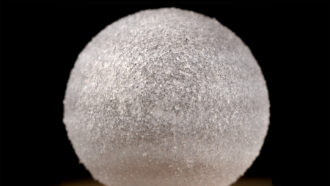
If you hate having your bubble burst, you’ll love these “everlasting” bubbles.
While soap bubbles are known for their fragile constitutions, the new bubbles can stick around for more than a year before they pop, scientists report January 18 in Physical Review Fluids.
Instead of soap and water, the bubbles are made with water, microparticles of plastic and a clear, viscous liquid called glycerol. That trio of ingredients staves off factors that normally hasten a bubble’s death.
In a standard soap bubble, gravity pulls liquid to the bottom of the bubble, leaving a thin film on the top that can easily rupture (SN: 1/12/17). Evaporation of the liquid film also saps bubbles’ stamina. In the everlasting bubbles, plastic particles cling to the water, maintaining the film’s thickness. Meanwhile, glycerol absorbs moisture from the air, counteracting evaporation.
“When we discovered that the bubble didn’t rupture after days we were really astonished,” says physicist Michael Baudoin of Université de Lille in France. So he and colleagues waited to see how long the bubbles would last. And waited, and waited. One bubble persisted 465 days before it burst, making it the longest-lived bubble ever produced under normal atmospheric conditions. That bubble turned slightly green before its demise, a potential hint at what caused it to finally pop. Microbes probably took up residence, weakening the bubble’s structure, the team suspects.
 These tiny snakes cartwheel to escape danger
  Japan’s sample return mission to Phobos may also collect some Mars dust
  Horned dinosaurs’ weapons evolved to handle the forces of combat
  Artemis II results show how much science people can do at the moon
  Crossword: Time lines
  Many American diets may not include enough of this essential nutrient
  Hunger is ‘an avoidable tragedy’ in a world of plenty: Türk
  UN condemns deadly wave of drone strikes in war-torn Sudan
  Guterres honours Indonesian troops who paid ‘ultimate sacrifice’
  ‘Season of fear’: Escalating Israeli attacks on West Bank olive farmers, deadly strikes on Gaza