
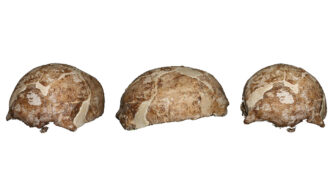
A previously undetected Homo sapiens population inhabited what’s now southwestern China around 14,000 years ago and contributed to the ancestry of ancient Americans.
This far-ranging Asian group’s evolutionary identity has been revealed thanks to ancient DNA extracted from a skullcap previously excavated at Mengzi Ren, or MZR, a site in southwestern China’s Red Deer Cave, researchers report July 14 in Current Biology.
The finding offers a rare opportunity to narrow down where the ancestors of ancient Americans came from in East Asia’s vast expanse.
Geneticist Bing Su of China’s Kunming Institute of Zoology and colleagues recovered nearly all the fossil individual’s mitochondrial DNA, typically inherited from the mother, and roughly 3.3 percent of the nuclear DNA, which is inherited from both parents.
Hominid fossils unearthed at Red Deer Cave in 1989 look like those of people today in some ways but in others resemble Asian Neandertals and Homo erectus (SN: 12/18/19). That unusual skeletal mix inspired a debate about whether the Chinese fossils represent H. sapiens or had different origins (SN: 12/17/15).
The new genetic analyses and comparisons with present-day and ancient people peg the MZR individual’s DNA as that of a female H. sapiens from southern East Asia. Much like East Asians today, the ancient female’s ancestry included small contributions from Denisovans and Neandertals.
Su’s group found that the MZR woman carried genetic ties to ancient people in the Americas who date to as early as about 12,000 years ago. Some ancient southern East Asians traveled up China’s eastern coast, possibly by way of Japan, and crossed a land bridge to North America, the scientists suspect.
 Horned dinosaurs’ weapons evolved to handle the forces of combat
  Artemis II results show how much science people can do at the moon
  Crossword: Time lines
  Many American diets may not include enough of this essential nutrient
  A telling hole in a Neandertal bone hints at a bitter end
  Brain implants are helping people who’ve lost their voice
  WHO scales up Ebola readiness in 22 countries across three continents
  Ukraine: Civilian casualty rates among ‘deadliest’ in years, as energy attacks intensify
  As disasters mount, next UN climate summit faces a test of trust
  Gaza: 340 children killed despite ceasefire agreement – UNICEF