
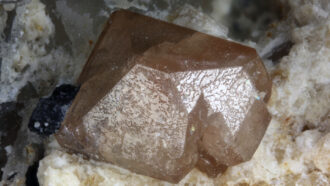
Earth’s crust may have gone on the move roughly 3.8 billion years ago.
A change in the chemistry of ancient zircon crystals from different bygone eras may be the earliest hint of subduction, the sliding of one tectonic plate under another, researchers report in the April AGU Advances. This shift may mark the first steps of processes that would evolve into modern plate tectonics on Earth (SN: 1/13/21). Before then, early Earth may have donned a relatively immobile “protocrust,” such as observed on Venus today, the team says.
“Earth is actually quite distinct to other planets, in that it has plate tectonics,” says study coauthor Nadja Drabon, a geochemist at Harvard University. “We’re trying to figure out, when did it become so special?”
Geologists have long debated what Earth’s crust looked like during the Hadean Eon, more than 4 billion years ago (SN: 3/16/17). One reason the debate has remained unresolved is that opportunities to investigate that distant past are scarce, as few rocks have survived the eons of tectonic activity.
But zircons — extremely resilient, bright gemstones — are renowned for their ability to last for billions of years (SN: 1/31/17). Geologists know this because they can reliably estimate zircon ages by measuring how much uranium and lead is in the crystal. Growing zircons readily capture uranium but tend to exclude lead, so any lead found in zircon is assumed to have decayed from uranium. Geologists know that decay rate, which is based on uranium’s half-life, so they can estimate the zircons’ age.
What’s more, zircons provide clues about the environments in which they formed, as their growing lattices of zirconium, silica and oxygen capture tiny amounts of other elements from their surroundings.
Most of the world’s Hadean zircons have been found in a just a dozen sites, and most of those are from a site in Australia. But since 2018, Drabon and her colleagues have reported on a new source: the Barberton Makhonjwa Mountains in South Africa. Dozens of zircons collected from that region crystallized between 4.15 to 4 billion years ago, while thousands of others are at least 3.3 billion years old. The findings have provided the researchers with a new, roughly 800-million-year window into the past, straddling the end of the Hadean and the beginning of the Archean Eon.
For the new study, the researchers peered through that window by checking the zircons for trace elements—uranium, scandium, ytterbium, niobium and cerium—and also for different forms of oxygen and hafnium.
Prior to 3.8 billion years ago, most of the zircons contained quantities of different forms of hafnium through time that supported the existence of an old, stable protocrust. What’s more, these older zircons contained trace elements at levels that were similar to those found in zircons from Hawaii’s volcanic hotspot. There, new rock is created as a plume of molten material rises from Earth’s mantle and crystallizes — a process that could have operated in the absence of moving plates.
But in the zircons that formed after 3.8 billion years ago, the researchers found no more evidence of a protocrust, and many of the zircons contained trace element signatures resembling those found today at subduction zones.
That’s a fundamental shift, says Jennifer Kasbohm, a geochronologist at Yale University who was not involved in the study. “We really consider subduction to be essential for plate tectonics.”
Previous analyses of zircons from other places, such as Australia and India, have reported similar compositions, the researchers note, suggesting that an early form of plate tectonics may have become widespread by around 3.8 billion years ago (SN: 4/9/21).
Moving forward, Drabon plans to investigate if other minerals were trapped inside the zircons during their formation. If so, those hitchhiking bits might open even more windows into Earth’s early tectonic history.
 Horned dinosaurs’ weapons evolved to handle the forces of combat
  Artemis II results show how much science people can do at the moon
  Crossword: Time lines
  Many American diets may not include enough of this essential nutrient
  A telling hole in a Neandertal bone hints at a bitter end
  Brain implants are helping people who’ve lost their voice
  WHO scales up Ebola readiness in 22 countries across three continents
  Ukraine: Civilian casualty rates among ‘deadliest’ in years, as energy attacks intensify
  As disasters mount, next UN climate summit faces a test of trust
  Gaza: 340 children killed despite ceasefire agreement – UNICEF