
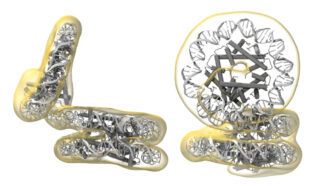
Single-celled archaea microbes pack their DNA into flexible coils that expand and stretch much like a Slinky does. This kind of molecular gymnastics had never been seen before in other organisms and may represent a way for archaea to get easy access to their genetic material, researchers report March 2 in eLife.
Some of the observed structures “really look like you take a Slinky and force it open, like a book,” says Karolin Luger, a Howard Hughes Medical Institute investigator at the University of Colorado Boulder. “You would think that this would really contort the DNA in an awful shape, but it actually flows very naturally.”
Similar to the cassette tapes she grew up listening to, DNA stores information in a very thin and fragile filament of nucleic acids, says Luger. But unlike the tapes, which often tangled and tore, rendering them useless, the genetic material can be read, split into two like a zipper and replicated without tangles and breaks –– all while remaining confined in an incredibly small compartment.
In 2017, Luger and her colleagues discovered that archaea — microbes that resemble bacteria under the microscope but are quite distinct — can spool their DNA around small proteins called histones (SN: 8/10/17). This process is strikingly similar to how plants, animals and fungi bend and fold their own genomes into compact, disk-shaped units known as nucleosomes.
But nobody knew what these structures looked like in archaea, or how the microbes gained access to their spooled DNA. Using computer simulations and electron microscopy experiments on the genetic material of Methanothermus fervidus, a heat-loving archaeal species, the researchers found the Slinky-like shapes opened and closed in a clamshell motion.
“My gut reaction was: ‘Wow! So pretty!’” says Luger. “My second reaction was: ‘Of course! This makes so much sense!’”
Complex organisms such as humans, palm trees or mushrooms depend on a sophisticated machinery to loosen their highly compacted nucleosomes and gain access to specific genes. Archaea microbes might instead simply be contorting their DNA to turn genes on and off –– allowing proteins to “read” the genes when the Slinkies open, and cutting off access when they close.
Luger now wishes to look at other strange archaea that live in extreme environments to confirm whether these bendable DNA Slinkies are “a general phenomenon, or whether other solutions have been invented for this DNA packaging problem.”
 Horned dinosaurs’ weapons evolved to handle the forces of combat
  Artemis II results show how much science people can do at the moon
  Crossword: Time lines
  Many American diets may not include enough of this essential nutrient
  A telling hole in a Neandertal bone hints at a bitter end
  Brain implants are helping people who’ve lost their voice
  Inside the New York ‘time machine’ racing to save a century of sound and film
  Two Summits in Bangkok: IMF/World Bank and Finance Ministers Inside, the People’s Assembly Outside
  CHINA: ‘My Sister Has Been in a Chinese Prison for Eight Years Because I Exercised My Freedom of Speech’
  COP17: The world has a plan to save nature. Is it working?