
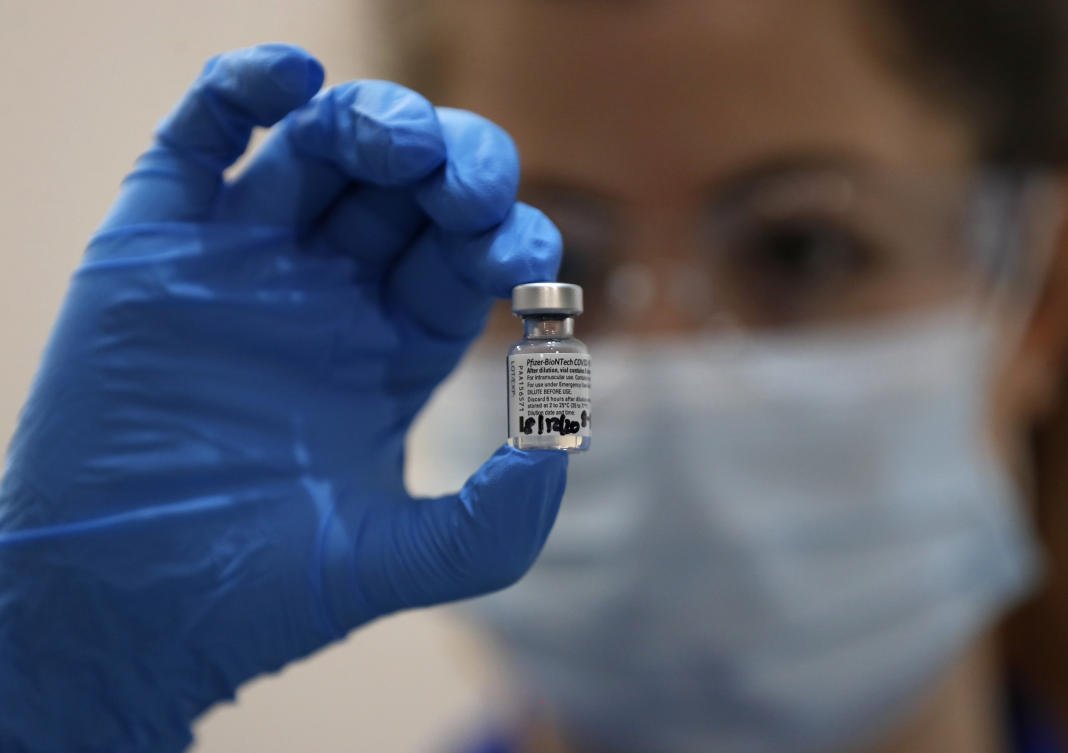
BERLIN: German pharmaceutical company BioNTech is confident that its coronavirus vaccine works against the new UK variant, but further studies are need to be completely sure, its chief executive said Tuesday.
The variant, detected mainly in London and the southeast of England in recent weeks, has sparked concern worldwide because of signs that it may spread more easily. While there is no indication it causes more serious illness, numerous countries in Europe and beyond have restricted travel from the UK as a result.
“We don’t know at the moment if our vaccine is also able to provide protection against this new variant,” Ugur Sahin told a news conference the day after the vaccine was approved for use in the European Union. “But scientifically, it is highly likely that the immune response by this vaccine also can deal with the new virus variants.”
Sahin said that the proteins on the UK variant are 99 percent the same as on the prevailing strains, and therefore BioNTech has “scientific confidence” that its vaccine will be effective.
“But we will know it only if the experiment is done and we will need about two weeks from now to get the data,” he said. “The likelihood that our vaccine works … is relatively high.”
Should the vaccine need to be adjusted for the new variant the company could do so in about 6 weeks, said Ugur, though regulators might have to approve the changes before the shots can be used.
BioNTech’s vaccine, developed together with US pharmaceutical company Pfizer, is authorized for use in more than 45 countries including Britain, the United States and the EU.
No evidence Pfizer vaccine won’t work against new strain: EMA chiefUS FDA authorizes Pfizer COVID-19 vaccine for emergency use
 A nanoparticle revealed the tiny impact of a single gas atom
  Was van Gogh’s ‘The Starry Night’ a flight of fancy or a real sky?
  This ‘living drug’ could change the course of autoimmune disease
  AI could turn scientific papers into research assistants
  A lifesaving medication is not behind the drop in U.S. overdose deaths
  Peek into hidden worlds revealed by the 2026 Nikon Small World contest
  World News in Brief: Russian attacks intensify, UN team tours West Bank, ‘unlawful’ elderly deaths
  Mothers get nearly eight times more paid leave than fathers – and women pay the price
  Nepal’s deadly glacier flood a ‘defining moment’ for the international community
  First human case of Shamonda virus reported in France as patient dies