
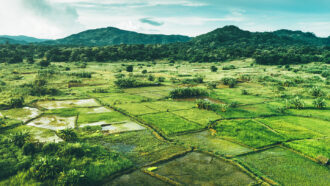
Humankind’s growing need for food is running up against thousands of other species’ need for space.
By 2050, humans may need to clear an additional 3.35 million square kilometers of land for agriculture. Converting these largely natural habitats, collectively about the size of India, would squeeze more than 17,000 vertebrate species from some of their lands, researchers report December 21 in Nature Sustainability.
But changing how, where and what food is grown can minimize the impacts, says conservation scientist David Williams of the University of Leeds in England. “We can feed the planet without screwing it up too badly.”
To figure out how, Williams and colleagues first identified habitats most likely to be cleared for cropland. The team then calculated the amount of food needed to sustain projected human population growth for 152 countries and mapped where crops would likely be grown in each, based in part on past land use changes. By 2050, the world’s 13 million square kilometers of cropland would need to increase by 26 percent, the team found. That growth is largely concentrated in sub-Saharan Africa, South and Southeast Asia.
The researchers then overlaid these estimates on distribution maps of nearly 20,000 species of birds, amphibians and mammals. While almost all of these species would lose some habitat, the team estimates that 1,280 species would lose at least 25 percent of their ranges, and 96 species would lose at least 75 percent.
Overhauling the global food system could nearly erase these biodiversity losses, the team says. Among the changes: improve crop yields, transition to more plant-based diets, halve food loss and waste and increase food imports for countries where agricultural expansion threatens the most species. Implementing all four tactics would actually shrink the world’s cropland area by 3.4 million square kilometers by midcentury and result in just 33 species losing more than a quarter of their natural range, the team found.
Achieving that may be politically unfeasible, Williams says, but less aggressive changes could still have big impacts. The world needs to feed a growing population, but it can be done more sustainably, he says. “It’s a no brainer.”
 In National Geographic’s “Expedition: Saving Our Seas,” it’s all hands on deck
 The ‘hell chicken’ dinosaur was a real terror — to fruit
 The brain’s fear center moonlights as the save button for memories
 Europe’s Hera mission is ready to double down on asteroid science
 Stone Age children left fingerprints on ancient art projects
 This magic mushroom can kill
 When the rains fail: Preparing for drought in Central America
 ‘Here, you can eat until you’re full’: Oleshky evacuees savour first proper meals in years
 COP31: National Oil Companies Must Lead Global Shift Away from Fossil Fuels, Says NRGI Expert
 COP31: Climate finance falls short as calls grow for polluters to pay