
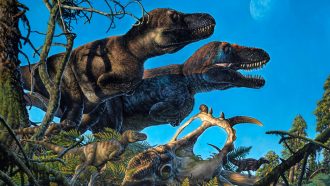
Dinosaurs didn’t just summer in the high Arctic; they may have lived there year-round, new fossil evidence suggests.
Hundreds of bones and teeth found along the Colville River in northern Alaska belonged to dinosaur hatchlings, researchers say. The remains, which fell from outcroppings of the Prince Creek Formation, represent seven dinosaur families including tyrannosaurs, duck-billed hadrosaurs and horned and frilled ceratopsids.
“These are the northernmost [non-avian] dinosaurs that we know of,” says paleontologist Patrick Druckenmiller of the University of Alaska Museum of the North in Fairbanks. And now it’s clear they’re not just migrating into polar latitudes, he says. “They’re actually nesting and laying and incubating eggs … practically at the North Pole.”
Some of these dinosaurs incubated their eggs for up to six months, previous evidence suggests (SN: 1/23/17). That would have left little time for any dinos nesting in the Arctic to migrate south before winter set in, Druckenmiller and colleagues report online June 24 in Current Biology. And any offspring would have struggled to make the long journey.
Hundreds of teeth and bones from baby dinosaurs, found in northern Alaska, are the best evidence yet that some dinosaurs nested and raised their young in the Arctic. Among the selection of remains shown are a tyrannosaur tooth (left), ceratopsid tooth (top left) and therapod bones (lower right).Patrick Druckenmiller
The Arctic was slightly warmer during the dinos’ lifetime than it is today. Between around 80 million and 60 million years ago, the region had an average annual temperature of about 6˚ Celsius — similar to that of modern-day Ottawa — fossilized plants from the Prince Creek Formation indicate. Still, overwintering dinosaurs would have endured months of darkness, cold temperatures and even snowfall, Druckenmiller says.
They may have fought the cold with insulating feathers or some degree of warm-bloodedness (SN: 4/4/12); SN: 6/13/14), and the herbivores may have hibernated or eaten rotten vegetation when fresh food diminished in the dark months, Druckenmiller speculates. Finding these baby dino fossils unearthed more questions than answers, he admits. “We’ve opened a whole can of worms.”
 These tiny snakes cartwheel to escape danger
  Japan’s sample return mission to Phobos may also collect some Mars dust
  Horned dinosaurs’ weapons evolved to handle the forces of combat
  Artemis II results show how much science people can do at the moon
  Crossword: Time lines
  Many American diets may not include enough of this essential nutrient
  Hunger is ‘an avoidable tragedy’ in a world of plenty: Türk
  UN condemns deadly wave of drone strikes in war-torn Sudan
  Guterres honours Indonesian troops who paid ‘ultimate sacrifice’
  ‘Season of fear’: Escalating Israeli attacks on West Bank olive farmers, deadly strikes on Gaza