
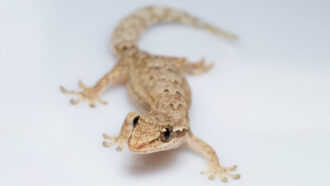
Regenerating body parts is never easy. For instance, some lizards can grow back their tails, but these new appendages are pale imitations of the original. Now, genetically modified stem cells are helping geckos grow back better tails.
Tweaking and implanting embryonic stem cells on the tail stumps of mourning geckos (Lepidodactylus lugubris) allowed the reptiles to grow tails that are more like the original than ever before, researchers report October 14 in Nature Communications. These findings are a stepping-stone to developing regenerative therapies in humans that may one day treat hard-to-heal wounds.
A gecko’s tail is an extension of its spine — with the vertebrae to prove it. Regenerated tails, however, are simpler affairs. “It’s just a bunch of concentric tubes of fat, muscle and skin,” says Thomas Lozito, a biologist at the University of Southern California in Los Angeles.
That’s because stem cells in adult geckos produce a molecular signal that encourages the formation of cartilage in new tails, but not bone or nervous tissues (SN: 8/17/18). Lozito and his colleagues used embryonic stem cells, which can develop into a wider range of tissues than adult stem cells, modified them to ignore this signal and then implanted them on the tail stumps of geckos that had their tails surgically removed. The tails that grew from these modified stem cells had bonelike grooves in the cartilage and generated new neural tissue at the top of the tail.
These modified tails still lack a spinal cord, making them a far cry from the original. “We fixed one problem, but there are still many imperfections,” Lozito says. “We’re still on the hunt for the perfect tail.”
A gecko’s original tail (left in these micro CT scans) boasts vertebrae, while a regrown tail (middle) grows solid blocks of cartilage. Modifying stem cells helped a tail form bonelike grooves in the cartilage (right), bringing it closer to its original blueprint.Lozito Lab/USCA gecko’s original tail (left in these micro CT scans) boasts vertebrae, while a regrown tail (middle) grows solid blocks of cartilage. Modifying stem cells helped a tail form bonelike grooves in the cartilage (right), bringing it closer to its original blueprint.Lozito Lab/USC
 These tiny snakes cartwheel to escape danger
  Japan’s sample return mission to Phobos may also collect some Mars dust
  Horned dinosaurs’ weapons evolved to handle the forces of combat
  Artemis II results show how much science people can do at the moon
  Crossword: Time lines
  Many American diets may not include enough of this essential nutrient
  Hunger is ‘an avoidable tragedy’ in a world of plenty: Türk
  UN condemns deadly wave of drone strikes in war-torn Sudan
  Guterres honours Indonesian troops who paid ‘ultimate sacrifice’
  ‘Season of fear’: Escalating Israeli attacks on West Bank olive farmers, deadly strikes on Gaza