
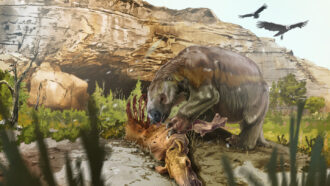
Modern sloths may be dedicated vegetarians, but at least one of their massive Ice Age cousins chowed down on meat when it had the chance. Darwin’s ground sloth — which could grow to over 3 meters long and weigh as much as about 2,000 kilograms — may have been an opportunistic scavenger, chemical analyses of fossil sloth hair suggest.
Paleontologist Julia Tejada of the University of Montpellier in France and colleagues analyzed the chemical makeup of two amino acids, the building blocks of proteins, within the fossil hair of two giant ground sloth species: Darwin’s ground sloth (Mylodon darwinii) of South America and the Shasta ground sloth (Nothrotheriops shastensis) of North America (SN: 4/25/18). The team compared these with samples from living sloths, anteaters and other modern omnivores.
Nitrogen isotopes, different forms of the element, can vary a lot among different food sources as well as between ecosystems. Those isotope values in one amino acid, glutamine, change significantly with diet, increasing the higher the animal is on the food chain. But diet has little impact on the nitrogen values in another amino acid, phenylalamine. By comparing the nitrogen isotopes in the two amino acids found in the sloths’ hair, the researchers were able to eliminate ecosystem effects and zoom in on diets.
The data reveal that while the diet of the Shasta ground slothwas exclusively plant-based, Darwin’s ground sloth was an omnivore, Tejada and colleagues report October 7 in Scientific Reports.
The findings upend what scientists thought they knew about the ancient animals. Scientists have assumed the ancient creatures were herbivores. That’s in part because all six modern species of sloth are confirmed vegetarians, and in part giant ground sloths’ teeth and jaws weren’t adapted for hunting or powerful chewing and tearing (SN: 6/20/16).
But Darwin’s ground sloth could have managed to ingest already-killed meat, Tejada and colleagues say. And that might help solve a long-standing puzzle: the apparent absence of large carnivorous mammals in South America at the time. Darwin’s ground sloth, the researchers add, may have filled a vacant ecological niche: the scavenger who wouldn’t say no to a meaty meal.
 These tiny snakes cartwheel to escape danger
  Japan’s sample return mission to Phobos may also collect some Mars dust
  Horned dinosaurs’ weapons evolved to handle the forces of combat
  Artemis II results show how much science people can do at the moon
  Crossword: Time lines
  Many American diets may not include enough of this essential nutrient
  As El Niño Returns, East Africa’s Urban Poor Brace for Heavy Rains
  Hunger is ‘an avoidable tragedy’ in a world of plenty: Türk
  UN condemns deadly wave of drone strikes in war-torn Sudan
  Guterres honours Indonesian troops who paid ‘ultimate sacrifice’