
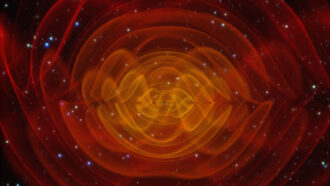
It sounds like the setup for a joke: If radio waves give you radar and sound gives you sonar, what do gravitational waves get you?
The answer might be “GRADAR” — gravitational wave “radar” — a potential future technology that could use reflections of gravitational waves to map the unseen universe, say researchers in a paper accepted to Physical Review Letters. By looking for these signals, scientists may be able to find dark matter or dim, exotic stars and learn about their deep insides.
Astronomers routinely use gravitational waves — traveling ripples in the fabric of space and time itself, first detected in 2015 — to watch cataclysmic events that are hard to study with light alone, such as the merging of two black holes (SN: 2/11/2016).
But physicists have also known about a seemingly useless property of gravitational waves: They can change course. Einstein’s theory of gravity says that spacetime gets warped by matter, and any wave passing through these distortions will change course. The upshot is that when something emits gravitational waves, part of the signal comes straight at Earth, but some might arrive later — like an echo — after taking longer paths that bend around a star or anything else heavy.
Scientists have always thought these later signals, called “gravitational glints,” should be too weak to detect. But physicists Craig Copi and Glenn Starkman of Case Western Reserve University in Cleveland, Ohio, took a leap: Working off Einstein’s theory, they calculated how strong the signal would be when waves scatter through the gravitational field inside a star itself.
“The shocking thing is that you seem to get a much larger result than you would have expected,” Copi says. “It’s something we’re still trying to understand, where that comes from — whether it’s believable, even, because it just seems too good to be true.”
If gravitational glints can be so strong, astronomers could possibly use them to trace the insides of stars, the team says. Researchers could even look for massive bodies in space that would otherwise be impossible to detect, like globs of dark matter or lone neutron stars on the other side of the observable universe.
“That would be a very exciting probe,” says Maya Fishbach, an astrophysicist at Northwestern University in Evanston, Ill., who was not involved in the study.
There are still reasons to be cautious, though. If this phenomenon stands up to more detailed scrutiny, Fishbach says, scientists would have to understand it better before they could use it — and that will probably be difficult.
“It’s a very hard calculation,” Copi says.
But similar challenges have been overcome before. “The whole story of gravitational wave detection has been like that,” Fishbach says. It was a struggle to do all the math needed to understand their measurements, she says, but now the field is taking off (SN: 1/21/21). “This is the time to really be creative with gravitational waves.”
 These deep-sea spiders give off an otherworldly glow
  These neutrinos from the sun have the lowest energies ever seen
  A human set a new mathematical record. Then AI came for it
  How the body adapts to extreme heat
  Historical art can hide scientific secrets
  The Sept. 11 disasters still shape people’s health 25 years later
  Global Survey Finds Deep Crisis of Trust as Majority Say Economic System Favours the Rich
  International Trade Theory Not Developmental