
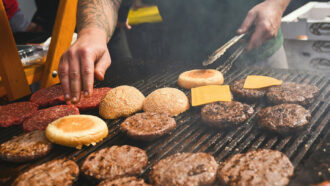
If you have a hankering for a hamburger, math may have some timesaving cooking tips for you.
Increasing the number of times a burger is flipped from one side to the other reduces its cook time by up to nearly a third, theoretical calculations suggest. But cooks at home probably won’t see much benefit out of more than three to four flips, mathematician Jean-Luc Thiffeault reports June 17 in Physica D.
Thiffeault used math to model how heat moves through an “infinite” slab of meat, which cooks continuously on only the bottom side and cools on the top until the meat is flipped. Flipping heated the meat evenly, speeding up cooking, the analysis showed. And more flips led to a faster cook. For example, flipping this theoretical 1-centimeter-thick patty just once gave it a cook time of 80 seconds, while flipping it 10 times at intervals ranging from six to 11 seconds resulted in a cook time of 69 seconds. Continuing to flip the burger led to a maximum decrease of 29 percent in cooking time.
But the timesaving benefit seemed to diminish as the number of flips increased beyond a certain threshold, says Thiffeault, of the University of Wisconsin–Madison. “After three or four flips, the gain in time is negligible.”
Thiffeault’s findings align with what chef and food writer J. Kenji López-Alt has observed in the kitchen. In a 2019 article for the food and drink website Serious Eats, Kenji López-Alt compared how long it took for a burger’s internal temperature to reach about 52° Celsius, or 125° Fahrenheit, based on cooking method. Flipping a burger every 15 seconds — as opposed to flipping the patty just once — shortened cooking time by nearly a third.
But there isn’t a one-size-fits-all way to cook a burger, Kenji López-Alt notes. “The idea of the perfect anything is just nonsense, right?” he says. “It’s all based on what you want.”
Thiffeault’s friends probably wouldn’t want his theoretical hamburger, the mathematician jokes. The infinite slab of meat is considered cooked when it reaches 70° Celsius, or 158° Fahrenheit. “That’s no burger that they would want to eat because it’s quite a well-done burger,” he says.
 Horned dinosaurs’ weapons evolved to handle the forces of combat
  Artemis II results show how much science people can do at the moon
  Crossword: Time lines
  Many American diets may not include enough of this essential nutrient
  A telling hole in a Neandertal bone hints at a bitter end
  Brain implants are helping people who’ve lost their voice
  WHO scales up Ebola readiness in 22 countries across three continents
  Ukraine: Civilian casualty rates among ‘deadliest’ in years, as energy attacks intensify
  As disasters mount, next UN climate summit faces a test of trust
  Gaza: 340 children killed despite ceasefire agreement – UNICEF