
It was the rift watched ‘round the world.
In July 2017, after weeks of anticipation, a massive iceberg about the size of Delaware split from the Antarctic Peninsula (SN: 7/12/17). Satellite images show that the orphaned iceberg, known as A68, ultimately disintegrated in the Southern Ocean. Now, researchers say they have pieced together the powerful forces that led to that final breakup.
Polar scientist Alex Huth of Princeton University and colleagues combined observations of the iceberg’s drift with simulations of ocean currents and wind stress. Iceberg A68a, the largest remaining chunk of the original berg, was caught in a tug-of-war of ocean currents, and the strain of those opposing forces probably pulled the iceberg apart, the team reports October 19 in Science Advances.
After A68’s separation from the Larsen C ice shelf, researchers had questions — such as what creatures live on the seafloor in the ice’s dark shadow (SN: 2/8/19). As for the iceberg itself, it took a while to get moving, lingering in the neighborhood for about a year (SN: 7/23/18). By December 2020, satellite images show, the berg had clearly seen some action and was just two-thirds of its original size.
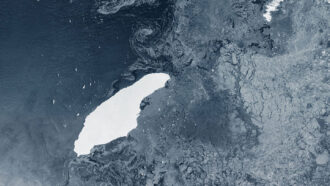
On December 19, 2020, a European Space Agency satellite spotted iceberg A68a with its slender “finger” still intact in the Southern Ocean. Two days later, the berg was crisscrossed with rifts, now thought to be the result of strain due to ocean currents. By the next day, the iceberg had fractured into smaller pieces that eventually disintegrated. A. Huth et al/Science Advances 2022On December 19, 2020, a European Space Agency satellite spotted iceberg A68a with its slender “finger” still intact in the Southern Ocean. Two days later, the berg was crisscrossed with rifts, now thought to be the result of strain due to ocean currents. By the next day, the iceberg had fractured into smaller pieces that eventually disintegrated. A. Huth et al/Science Advances 2022
The new simulations suggest how A68a probably met its fate. On December 20, 2020, the long, slender “finger” at one end of the iceberg drifted into a strong, fast-moving current. The rest of the ice remained outside the current. The tension rifted the berg, and the finger sheared off and broke apart within a few days.
Shear stress is a previously unknown mechanism for large iceberg breakup, and isn’t represented in climate simulations, the team says. In the Southern Ocean, the melting of massive bergs can be a large source of cold freshwater to the ocean surface. That, in turn, can have a big impact on ocean circulation and the global climate.
 Many American diets may not include enough of this essential nutrient
  A telling hole in a Neandertal bone hints at a bitter end
  Brain implants are helping people who’ve lost their voice
  Can math stay human in the age of AI?
  Tiny implants can use the body itself to talk to each other
  Voyager 1 is nearly one light-day from Earth. What’s out there?
  If the UN COP17 Is Serious About Biodiversity, It Needs to Follow the Money
  ‘Prioritize Social Inclusion as Rapid Transformations Risk Leaving Millions Behind’
  Finding Silver Linings Amid Haze of Climatic Uncertainty
  Could your brain data be used against you? UN calls for limits on neurotechnology