
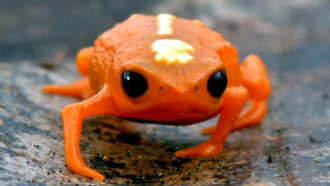
Some frogs just can’t stick the landing.
After launching into a leap, pumpkin toadlets careen through the air as if flung from a toddler’s fist. They roll, cartwheel or backflip and then plummet to the ground, often belly flopping or crash-landing on their backs.
“I’ve looked at a lot of frogs and these are the weirdest things I’ve ever seen,” says Richard Essner, Jr., a vertebrate zoologist at Southern Illinois University Edwardsville.
Essner and colleagues now propose an explanation for why the tiny frogs are such clumsy jumpers. The animals lack the proper gyroscopic equipment to sense small changes in rotation, the team suggests June 15 in Science Advances.
Brachycephalus pernix frogs have trouble sensing small changes in rotation, which makes landing jumps difficult, a new study suggests. The frogs can roll, cartwheel or backflip through the air, and then hit the ground on their backs or bellies.
When Essner saw videos of Brachycephalus frogs’ awkward aerial maneuvers, he was so shocked that he hopped on a plane to study the animals with his colleagues in Brazil. Small enough to fit on a person’s thumbnail, the frogs are tricky to find in the wild. Scientists listen for the amphibians’ high-pitched, buzzy calls and then scoop leaf litter into a bag, hoping to find a few toadlets.
In the lab, the team used high-speed video to record more than 100 tiny frog jumps. The klutzy tumbles suggested that the toadlets have trouble orienting themselves in space.
Typically, fluid sloshing through bony tubes in the inner ear help vertebrates sense their body’s position. CT scans revealed that the frogs’ tubes are the smallest ever recorded for adult vertebrates. Studies of other tiny animals suggest that the tubes don’t work so well in miniature. It’s difficult for the fluid to flow freely, Essner says. That means the frogs probably can’t sense how they’re twirling through the air, making it tough to prep for landing.
It’s possible that bony back plates offer some species crash protection, but the animals may stay grounded for safety (SN: 4/3/19). As Essner observed, the frogs are “almost always crawling really slowly.”
 Horned dinosaurs’ weapons evolved to handle the forces of combat
  Artemis II results show how much science people can do at the moon
  Crossword: Time lines
  Many American diets may not include enough of this essential nutrient
  A telling hole in a Neandertal bone hints at a bitter end
  Brain implants are helping people who’ve lost their voice
  COP17: The world has a plan to save nature. Is it working?
  Flour sacks turned flood barriers: Gaza faces another winter without safe shelter
  WHO scales up Ebola readiness in 22 countries across three continents
  Ukraine: Civilian casualty rates among ‘deadliest’ in years, as energy attacks intensify