
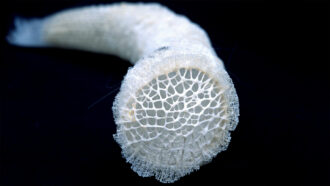
A Venus’s-flower-basket isn’t all show. This stunning deep-sea sponge can also alter the flow of seawater in surprising ways.
A lacy, barrel-shaped chamber forms the sponge’s glassy skeleton. Flow simulations reveal how this intricate structure alters the way water moves around and through the sponge, helping it endure unforgiving ocean currents and perhaps feed and reproduce, researchers report online July 21 in Nature.
Previous studies have found that the gridlike construction of a Venus’s-flower-basket (Euplectella aspergillum) is strong and flexible. “But no one has ever tried to see if these beautiful structures have fluid-dynamic properties,” says mechanical engineer Giacomo Falcucci of Tor Vergata University of Rome.
Harnessing supercomputers, Falcucci and colleagues simulated how water flows around and through the sponge’s body, with and without different skeletal components such as the sponge’s myriad pores. If the sponge were a solid cylinder, water flowing past would form a turbulent wake immediately downstream that could jostle the creature, Falcucci says. Instead water flows through and around the highly porous Venus’s-flower-basket and forms a gentle zone of water that flanks the sponge and displaces turbulence downstream, the team found. That way, the sponge’s body endures less stress.
Ridges that spiral around the outside of the sponge’s skeleton also somehow cause water to slow and swirl inside the structure, the simulations showed. As a result, food and reproductive cells that drift into the sponge would become trapped for up to twice as long as in the same sponge without ridges. That lingering could help the filter feeders catch more plankton. And because Venus’s-flower-baskets can reproduce sexually, it could also enhance the chances that free-floating sperm encounter eggs, the researchers say.
It’s amazing that such beauty could be so functional, Falcucci says. The sponge’s flow-altering abilities, he says, might help inspire taller, more wind-resistant skyscrapers.
This simulation shows how water flows around and through a Venus’s-flower-basket (gray). Ridges that spiral across the outside of the sponge cause water inside to somehow slow and swirl, forming particle-trapping vortices. And the sponge’s shape creates a gentle zone of slower water that forms immediately downstream, buffering the creature against turbulence. Vertical cross sections contrast the flow activity of the calm zone (nearer the sponge) and the turbulent zone (downstream).G. Falcucci et al/Nature 2021
 Light is hard to block from every direction. This physicist found a way
 Science to restore speech is moving fast. Here’s what’s next
 Toxic secrets are hiding in Arctic ice
 Fossil fuel emissions are down in 2026. Green energy isn’t the reason
 Drugs like Ozempic may help reverse chronic kidney disease
 A high-fiber diet may clear away plastic in the gut
 Egypt: Fact-checking site’s entire newsroom jailed as assault on press freedom widens
 Nearly 64,000 flee Nigeria for Niger where a humanitarian crisis is deepening
 Ebola: IOM urges wider surveillance beyond formal routes in DR Congo