
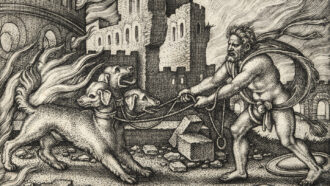
In Tom Edison’s Shaggy Dog, a short story by Kurt Vonnegut, Thomas Edison discovers that dogs are intellectually superior beings. They’re so smart, in fact, that the canines found the easiest possible way to survive: endearing themselves to humans. When Edison confronts his own dog about this revelation, the dog says, “Look, Mr. Edison. Why not keep quiet about this? It’s been working out to everybody’s satisfaction for hundreds of thousands of years. Let sleeping dogs lie.”
It’s true that humankind’s close relationship with canines spans millennia (SN: 7/18/17). This long-term interspecies friendship is a topic of intense scientific study, though where, when and even why it began remains murky (SN: 7/6/17). Short a talking dog, scientists have had to rely on archaeological and genetic evidence for clues (SN: 6/2/16). But the similarities between wolves and early domesticated dogs can make it challenging for researchers to tell them apart. In the earliest days, before wolves were fully domesticated, perhaps the most notable difference is simply the animals’ involvement with people.
That’s where storytelling can help, says historian Julien d’Huy of the College of France in Paris. Our penchant for mythologizing canine companions may be just as ancient as our relationship with them, so d’Huy is turning to these stories in a bid to shed more light on the history of dog domestication.
Some historians argue that using mythology to track human migration and the spread of information is unreliable because stories change quickly (SN: 1/19/16). D’Huy disagrees: Dogs play a starring role in many cultural origin stories, and since these myths are central to identity, that gives them stability over time, he says.
“With mythology, we can have explanations of archaeology, we can have reasons for domestication, we can test hypotheses,” he says.
D’Huy found three core storylines for the earliest myths related to dogs: The first links dogs with the afterlife, the second relates to the union of humans and dogs, and the third associates a dog with the star Sirius. Versions of these stories are found in many cultural regions around the world. He then borrowed statistical tools from biology to create family trees of myths, showing how the stories evolved as they followed humans from one region of the world to another.
Folktales about dogs stemmed from Central and Eastern Asia and spread to Europe, the Americas and later Australia and Africa, d’Huy reports in the June Anthropozoologica. This mythological travel route parallels a proposed path of dog domestication borne out by genetic and fossil evidence (SN: 3/1/21).
“This was a surprise,” d’Huy says. He wasn’t sure if dogs and our mythology about them would migrate together.
“It is certainly arguable that dogs were first domesticated in Asia,” says Pat Shipman, a retired paleoanthropologist and author of Our Oldest Companions: The Story of the First Dogs. Using mythology is a clever way to peer into the past, she says, because it can provide insight into how ancient humans valued dogs.
The prevalence of ancient myths identifying dogs as guides to the afterlife hint that our ancestors initially domesticated wolves not for hunting partners, as commonly believed, but for spiritual and symbolic reasons, d’Huy argues. This hypothesis fits with certain archaeological finds, he says, such as a 14,000-year-old grave in Germany containing a couple and two dogs. The woman was found with her hand resting on one of the dogs’ heads.
D’Huy is applying these methods to study how ancient myths can inform what we know about our connection with other animals such as sheep — their mythological link with the sun could have led to domestication. Symbolic, rather than utilitarian, reasons for domestication could explain a lot of data, he says.
“Comparative mythology has something to say in the world of research,” he says. “Something very precious to say, I think.”
 Horned dinosaurs’ weapons evolved to handle the forces of combat
  Artemis II results show how much science people can do at the moon
  Crossword: Time lines
  Many American diets may not include enough of this essential nutrient
  A telling hole in a Neandertal bone hints at a bitter end
  Brain implants are helping people who’ve lost their voice
  Guterres urges faster action and financing to stop biodiversity loss
  Ebola Spread Raises Fresh Urgency for Africa’s Domestic Health Funding