
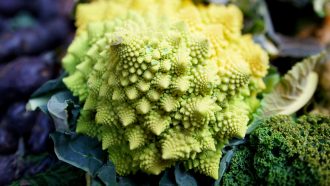
The swirling green cones that make up the head of Romanesco cauliflower also form a fractal pattern — one that repeats itself on multiple scales. Now, the genes that underlie this stunning structure have been identified, and the fractal pattern has been replicated in a common lab plant, Arabidopsis thaliana, researchers report in the July 9 Science.
“Romanesco is one of the most conspicuous fractal shapes that you can find in nature,” says Christophe Godin, a computer scientist with the National Institute for Research in Digital Science and Technology who is based at ENS de Lyon in France. “The question is, why is that so?” The answer has long eluded scientists.
Godin and his colleagues knew an Arabidopsis variant could produce small cauliflower-like structures. So the team manipulated the genes of A. thaliana in both computer simulations and growing experiments in the lab. Working with the extensively studied plant helped the researchers simplify their experiments and distill the essential fractal-spawning mechanism (SN: 6/15/21).
By altering three genes, the researchers grew a Romanesco-like head on A. thaliana. Two of those genetic tweaks hampered flower growth and triggered runaway shoot growth. In place of a flower, the plant grows a shoot, and on that shoot, it grows another shoot, and so on, says plant biologist François Parcy at CNRS in Paris. “It’s a chain reaction.”
The researchers then altered one other gene, which increased the growing area at the end of each shoot and provided space for spiraling conical fractals to form. “You don’t need to change the genetics much to get this form to appear,” says Parcy. The team’s next step, he says, “will be to manipulate these genes in cauliflower.”
 These tiny snakes cartwheel to escape danger
  Japan’s sample return mission to Phobos may also collect some Mars dust
  Horned dinosaurs’ weapons evolved to handle the forces of combat
  Artemis II results show how much science people can do at the moon
  Crossword: Time lines
  Many American diets may not include enough of this essential nutrient
  Hunger is ‘an avoidable tragedy’ in a world of plenty: Türk
  UN condemns deadly wave of drone strikes in war-torn Sudan
  Guterres honours Indonesian troops who paid ‘ultimate sacrifice’
  ‘Season of fear’: Escalating Israeli attacks on West Bank olive farmers, deadly strikes on Gaza