
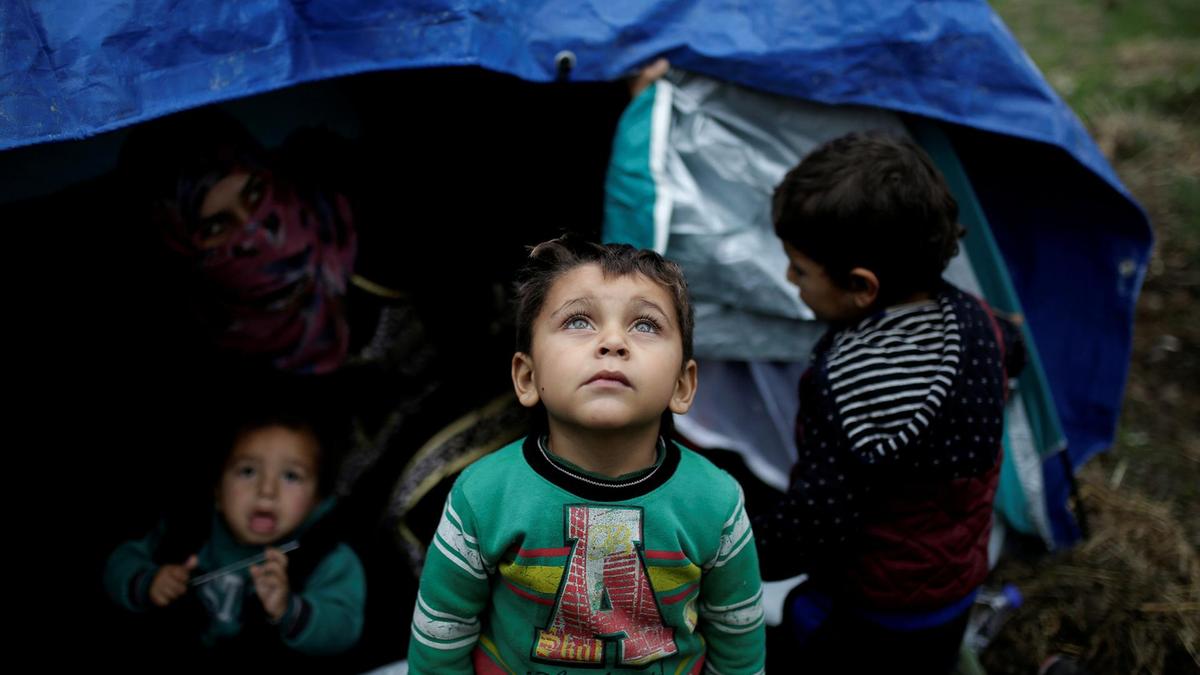
LONDON: Time is running out for up to 20 refugee children stranded in Greece to join their relatives in the UK under an EU family-reunification program that will come to an end when Britain leaves the EU.
The UK’s Home Office has warned it will not allow the refugee children — many of them fleeing war-torn Syria — to join their families in the UK if their cases do not make it through the Greek asylum system by Dec. 31.
Once Britain leaves the EU, more narrow family reunion laws that do not allow people to join siblings, aunts or uncles will apply.
The Home Office has ruled out extending the deadline for children, some of whom are homeless, to enter the UK despite delays in the Greek asylum process caused by COVID-19, The Guardian newspaper reported on Thursday.
The families of some of the children trapped in Greece have urged the British government to extend the deadline and allow the children to reunite with their families.
One Syrian refugee living in the UK has a niece and nephew stranded in Greece whose cases have been delayed.
He fears they could be returned to their hometown of Afrin in northern Syria, which is under the control of Turkey-backed militias.
“The situation there is not just bad, it is very bad. There are many terrorist groups, Isis (Daesh), al-Nusra. They have destroyed our villages. If I was to tell you about the situation for the children of Afrin I would speak all day. There is no future, no education,” he told The Guardian.
“We hope the UK will help all the children who are alone and have family waiting to care for them. I have a great, peaceful life here. I want my niece and nephew to be part of it.” He added: “From every family with a child in Greece, please help us.”
The EU’s Dublin Law allows for refugees under the age of 18 to apply for a transfer to elsewhere in the bloc if they have family living there, but the request must come from their country of arrival once they have been granted asylum there.
Sandy Protogerou, head of NGO Safe Passage International in Greece, urged the UK to be more flexible.
“Children are waiting longer than usual for cases to be processed here, partly because of the Covid situation. We have about 20 cases waiting now and we understand that the Greeks are trying to prioritise UK cases because of the urgency,” she said.
“But it is the UK Home Office who request that cases are officially registered first in Greece. So it is only the UK who can be flexible on the requirements of the Dublin system. Several of our young people are from Syria, they are trapped all over Greece, some are homeless, there is huge pressure on accommodation for refugees here.”
The Home Office said it is fulfilling its legal obligations under the EU family reunification scheme and will process all cases that enter the system in the UK before the end of the transition period.
German prosecutors charge Syrian doctor with murder, tortureBreakthrough: UK and EU reach post-Brexit trade agreement
 Eating too much sugar on antibiotics could squash helpful gut bacteria
  Electric stoves could help people with asthma breathe easier
  A nanoparticle revealed the tiny impact of a single gas atom
  Was van Gogh’s ‘The Starry Night’ a flight of fancy or a real sky?
  This ‘living drug’ could change the course of autoimmune disease
  AI could turn scientific papers into research assistants
  World News in Brief: Russian attacks intensify, UN team tours West Bank, ‘unlawful’ elderly deaths
  Mothers get nearly eight times more paid leave than fathers – and women pay the price