
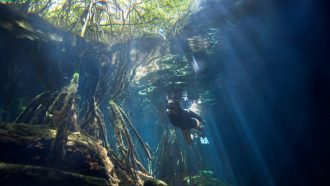
Coastal mangrove forests are carbon storage powerhouses, tucking away vast amounts of organic matter among their submerged, tangled root webs.
But even for mangroves, there is a “remarkable” amount of carbon stored in small pockets of forest growing around sinkholes on Mexico’s Yucatan Peninsula, researchers report May 5 in Biology Letters. These forests can stock away more than five times as much carbon per hectare as most other terrestrial forests.
There are dozens of mangrove-lined sinkholes, or cenotes, on the peninsula. Such carbon storage hot spots could help nations or companies achieve carbon neutrality — in which the volume of greenhouse gas emissions released into the atmosphere is balanced by the amount of carbon sequestered away (SN: 1/31/20).
At three cenotes, researchers led by Fernanda Adame, a wetland scientist at Griffith University in Brisbane, Australia, collected samples of soil at depths down to 6 meters, and used carbon-14 dating to estimate how fast the soil had accumulated at each site. The three cenotes each had “massive” amounts of soil organic carbon, the researchers report, averaging about 1,500 metric tons per hectare. One site, Casa Cenote, stored as much as 2,792 metric tons per hectare.
Mangrove roots make ideal traps for organic material. The submerged soils also help preserve carbon. As sea levels have slowly risen over the last 8,000 years, mangroves have kept pace, climbing atop sediment ported in from rivers or migrating inland. In the cave-riddled limestone terrain of the Yucatan Peninsula, there are no rivers to supply sediment. Instead, “the mangroves produce more roots to avoid drowning,” which also helps the trees climb upward more quickly, offering more space for organic matter to accumulate, Adame says.
As global temperatures increase, sea levels may eventually rise too quickly for mangroves to keep up (SN: 6/4/20). Other, more immediate threats to the peninsula’s carbon-rich cenotes include groundwater pollution, expanding infrastructure, urbanization and tourism.
 Science to restore speech is moving fast. Here’s what’s next
 Toxic secrets are hiding in Arctic ice
 Fossil fuel emissions are down in 2026. Green energy isn’t the reason
 Drugs like Ozempic may help reverse chronic kidney disease
 A high-fiber diet may clear away plastic in the gut
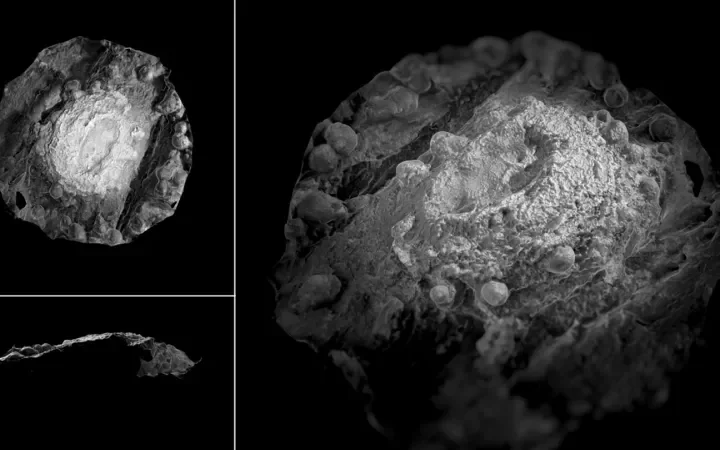 This may be the best evidence yet that dinosaur blood can fossilize
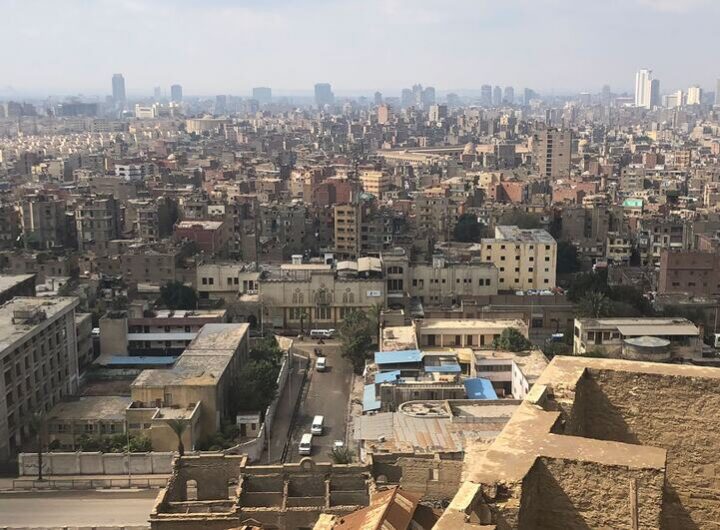 Egypt: Fact-checking site’s entire newsroom jailed as assault on press freedom widens
 Nearly 64,000 flee Nigeria for Niger where a humanitarian crisis is deepening
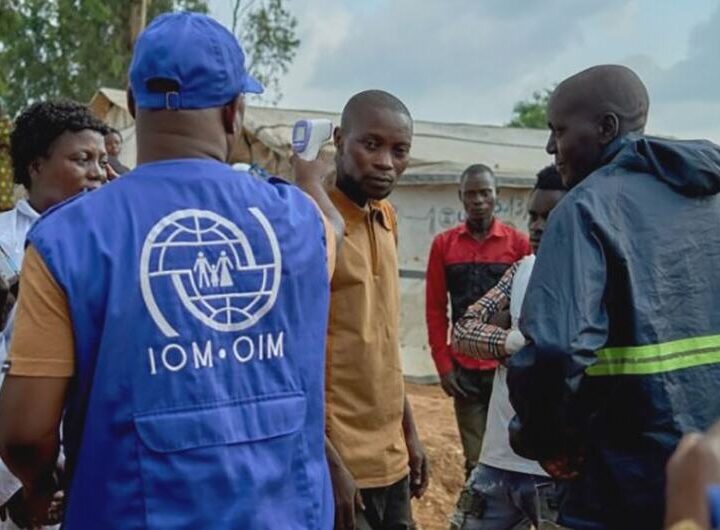 Ebola: IOM urges wider surveillance beyond formal routes in DR Congo
 World News in Brief: Ending cholera by 2030 ‘within reach’, Haiti displacement and hunger, US human rights review rescheduled