
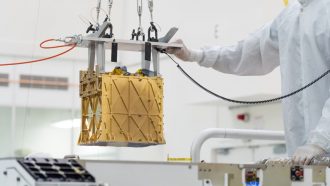
NASA’s Perseverance rover just created a breath of fresh air on Mars. An experimental device on the rover split carbon dioxide molecules into their component parts, creating about 10 minutes’ worth of breathable oxygen. It was also enough oxygen to make tiny amounts of rocket fuel.
The instrument, called MOXIE (Mars Oxygen In-Situ Resource Utilization Experiment), is about the size of a toaster (SN: 7/28/20). Its job is to break oxygen atoms off carbon dioxide, the primary component of Mars’ atmosphere. It’s like “an electrical tree,” says principal investigator Michael Hecht of MIT. “We breathe in CO2 and breathe out oxygen.”
MOXIE flew to Mars with Perseverance, which arrived on the Red Planet on February 18 (SN: 2/22/21). On April 20, the instrument warmed up to about 800° Celsius and ran for long enough to produce five grams of oxygen. That’s not enough to breathe for very long. But the main reason to make oxygen on Mars isn’t for breathing, Hecht says. It’s for making fuel for the return journey to Earth.
“When we burn anything, gas in the car or a log in the fireplace, most of what we’re burning is oxygen,” Hecht says. On Earth, we take all that oxygen for granted. “It’s free here. We don’t think about it.”
Future astronauts will have to either bring oxygen with them or make it on Mars. A rocket powerful enough to lift a few astronauts off the Red Planet’s surface would need about 25 metric tons of oxygen — too much to pack for the journey.
MOXIE is a prototype for the device astronauts could use to make rocket fuel in the future. When running at full power, the instrument can create about 10 grams of oxygen per hour. The instrument, powered by Perseverance, will run for about one Martian day at a time. A scaled-up version could run continuously for 26 months before astronauts arrive, Hecht says.
MOXIE can’t run continuously because Perseverance needs to divert its power back to its other instruments to continue its science mission of searching for signs of past life on Mars (SN: 1/10/18). MOXIE will get a chance to run at least nine more times over the next Martian year (about two Earth years).
The success of the technology could set the stage for a permanent research station on Mars, like the McMurdo station in Antarctica, something Hecht would like to someday see. “That’s not something I expect to see in my lifetime, but something I expect to see progress towards in my lifetime,” he says. “MOXIE brings it closer by a decade.”
 Horned dinosaurs’ weapons evolved to handle the forces of combat
  Artemis II results show how much science people can do at the moon
  Crossword: Time lines
  Many American diets may not include enough of this essential nutrient
  A telling hole in a Neandertal bone hints at a bitter end
  Brain implants are helping people who’ve lost their voice
  COP17: The world has a plan to save nature. Is it working?
  Flour sacks turned flood barriers: Gaza faces another winter without safe shelter
  WHO scales up Ebola readiness in 22 countries across three continents
  Ukraine: Civilian casualty rates among ‘deadliest’ in years, as energy attacks intensify