
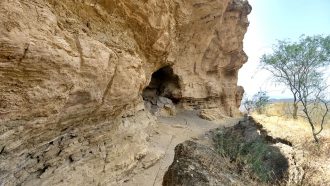
Humans may have inhabited what’s now southern Mexico surprisingly early, between 33,448 and 28,279 years ago, researchers say.
If so, those people arrived more than 10,000 years before folks often tagged as the first Americans (SN: 7/11/18). Other preliminary evidence puts humans in central Mexico as early as around 33,000 years ago (SN: 7/22/20).
The latest evidence comes from animal bones that biological anthropologist and archaeologist Andrew Somerville and two Mexican colleagues found stored in a Mexico City lab. The bones had been excavated in the 1960s at a rock-shelter called Coxcatlan Cave.
Radiocarbon analyses of six rabbit bones from the site’s deepest sediment yielded unexpectedly old ages, the researchers report online May 19 in Latin American Antiquity. That sediment also contained chipped and sharp-edged stones regarded as tools by the site’s lead excavator.
Higher sediment layers yielded clearer examples of stone tools and other remnants of human activity dating to nearly 9,900 years ago. Somerville, of Iowa State University in Ames, initially suspected that rabbit bones from the deepest sediment were perhaps around 12,000 years old. But analyses revealed they were much older, hinting humans were living in the cave roughly 30,000 years ago.
Somerville will next determine whether other animal bones from the ancient sediment display butchery marks, breaks where marrow was removed or burned patches from cooking. He also wants to locate and study possible stone tools from that same sediment that may be stored in the same lab.
Based on additional radiocarbon dates and comparisons with stone-tool finds from other Mexican sites, Somerville suspects that a separate occupation of Coxcatlan Cave occurred between 13,500 and 9,900 years ago. Regional food and water sources may have dwindled when the last Ice Age peaked between 26,000 and 19,000 years ago, causing the earliest settlers to leave and delaying further occupations until conditions improved, Somerville speculates.
 These mice have human (nerve cells) on the brain
  The U.S. has weapons in space. Here’s what that could mean
  Alzheimer’s damage may begin outside the brain
  Meet Swiftiephylus, an Australian bug named after Taylor Swift
  ‘Bogland’ explores beautifully strange ecosystems
  Feeling nervous? Work the system
  UN report warns of reprisals against those who collaborate in defence of human rights
  Gaza: At least 20 killed in deadly building collapse, search for survivors continues
  Security Council LIVE: ‘Being a woman is a crime in Afghanistan,’ civil society briefer declares
  AI, climate and conflicts top Guterres’s agenda ahead of General Assembly