
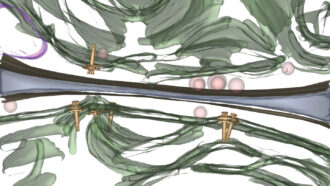
Some bacteria carry tiny syringes filled with chemicals that may thin out competitors or incapacitate predators. Now, researchers have gotten up-close views of these syringes, technically known as contractile injection systems, from a type of cyanobacteria and a marine bacterium.
Figuring out how key parts of the molecular syringes work may help scientists devise their own nanomachines. Artificial injection machines could direct antibiotics against troublesome bacteria while leaving friendly microbes untouched.
Genes encoding pieces of the injection machinery are found in many bacterial species. But, “just by looking at the genes, it’s quite hard to predict how these contractile injection systems work,” says Gregor Weiss, a cellular structural biologist at ETH Zurich.
So Weiss and colleagues examined bacterial syringes using cryo-electron microscopy, in which cells are flash frozen to capture cellular structures as they typically look in nature (SN: 6/22/17).
Previously, researchers have found syringes anchored in some bacteria’s outer membranes, where the bacteria can shoot their payload into cells they bump into. Other species’ injectors squirt their contents into the environment.
But in a type of cyanobacteria called Anabaena, the syringes are in an unusual place, nestled in the membrane of the internal structure where the bacteria carry out photosynthesis, Weiss and colleagues report in the March Nature Microbiology. Buried inside the cells, “it’s hard to imagine how [the syringes] could get out and interact with the target organism,” Weiss says.
Scientists were surprised to find injection systems, like the one shown in this cryo-electron microscopy image (arrow), from the cyanobacterium Anabaena in membranes inside the bacterial cell, instead of studding the outer membrane.G.L. Weiss et al/Nature Microbiology 2022
Anabaena may use its syringes against itself to trigger programmed cell death when the cyanobacteria come under stress. In the team’s experiments, ultraviolet light or high salt levels in water triggered some syringes to dump their payload. That led to the death of some Anabaena cells in the long chains that the cyanobacteria grow in, forming hollow “ghost cells.”
Ghost cells shed their outer wall and membrane, exposing unfired syringes in the inner membrane to the outside. The ghosts may act like Trojan horses, delivering their deadly payload to predators or competitors, the team hypothesizes. The researchers haven’t yet found which organisms are the probable targets of Anabaena’s syringes.
Inside a type of marine bacteria called Algoriphagus machipongonensis, the story is a bit different. Here, the syringes have a different architecture and float unmoored within the bacterial cell, ETH Zurich’s Charles Ericson and colleagues report in the March Nature Microbiology. The injectors are also found in the liquid in which the bacteria are grown in the laboratory, but how they get out of the cell is a mystery. Perhaps they are released when the bacteria die or get eaten by a predator, Ericson says.
The team also found two proteins loaded inside the Algoriphagus’ syringes, but what those proteins do isn’t known. The researchers tried genetically engineering E. coli to produce one of the proteins, but it kills the bacteria, says study coauthor Jingwei Xu, also at ETH Zurich.
Both the cyanobacterium Anabaena and the marine bacterium Algoriphagus machipongonensis have molecular syringes with a sheath stretched over an inner tube filled with chemicals, as seen in these reconstructions. The cyanobacterium’s syringes (one at top) are anchored to a membrane inside the bacterial cell. Some signal, such as stress, causes a ring at the syringe’s base to open, and the inner tube shoots out. The marine bacterium’s syringes (bottom) float freely inside the cell. Short fibers at its base (blue) may trigger the ejection of its tube when they latch on a target organism.Top: G.L. Weiss et al/Nature Microbiology 2022, Bottom: J. Xu et al/Nature Microbiology 2022
Comparing the structures of syringes from various species, the researchers identified certain structures within the machines that are similar, but slightly different from species to species. Learning how those modifications change the way the injectors work may allow researchers to load different cargoes into the tubes or target the syringes against specific bacteria or other organisms. “Now we have the general blueprint,” Ericson says, “can we re-engineer it?”
 A quantum computing feat brings the ‘megaquops’ era a step closer
  AI can give you your voice back
  These tiny snakes cartwheel to escape danger
  Japan’s sample return mission to Phobos may also collect some Mars dust
  Horned dinosaurs’ weapons evolved to handle the forces of combat
  Artemis II results show how much science people can do at the moon
  Yemen war continues to force families from homes amid hunger and disease
  Afghan Women Defy Taliban Restrictions Through Online Protests
  Food Insecurity and Child Malnutrition Worsen in Afghanistan Despite Strong Agricultural Season
  People Who Choose to End Their Lives