
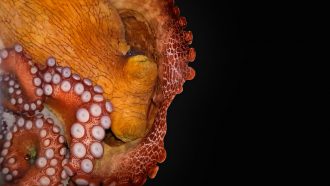
Octopuses cycle through two stages of slumber, a new study reports.
First comes quiet sleep, and then a shift to a twitchy, active sleep in which vibrant colors flash across the animals’ skin. These details, gleaned from four snoozing cephalopods in a lab in a Brazil, may provide clues to a big scientific mystery: Why do animals sleep?
Sleep is so important that every animal seems to have a version of it, says Philippe Mourrain, a neurobiologist at Stanford University who recently described the sleep stages of fish (SN: 7/10/19). Scientists have also catalogued sleep in reptiles, birds, amphibians, bees, mammals and jellyfish, to name a few. “So far, we have not found a single species that does not sleep,” says Mourrain, who was not involved in the new study.
Cephalopod neuroscientist and diver Sylvia Medeiros caught four wild octopuses, Octopus insularis, and brought them temporarily into a lab at the Brain Institute of the Federal University of Rio Grande do Norte in Natal, Brazil. After tucking the animals away in a quiet area, she began to carefully record their behavior during the day, when octopuses are more likely to rest.
Two distinct states emerged, she and her colleagues report March 25 in iScience. In the first, called quiet sleep, the octopuses are pale and motionless with the pupils of their eyes narrowed to slits. Active sleep comes next. Eyes dart around, suckers contract, muscles twitch, skin textures change and, most dramatically, bright colors race across octopuses’ bodies. This wild sleep is rhythmic, happening every half an hour or so, and brief; it’s over after about 40 seconds. Active sleep is also rare; the octopuses spent less than 1 percent of their days in active sleep, the researchers found.
Active sleep in octopuses is somewhat like REM sleep in people, Medeiros says. But because octopuses’ active sleep is so short, their sleep cycles more closely resemble the sleep of reptiles and birds, says study coauthor Sidarta Ribeiro, a neuroscientist also at the Brain Institute.
The results are consistent with recent work on sleeping cuttlefish, another cephalopod, says neuroethologist Teresa Iglesias of the Okinawa Institute of Science and Technology in Japan. “I’m thrilled by the progress and interest in cephalopod sleep research,” she says.
In people, sleep is thought to allow the brain to organize itself, getting rid of useless information and strengthening helpful memories (SN: 5/12/16). “It comes to mind immediately that the octopus is very smart,” Ribeiro says. Perhaps a similar sorting process happens in the sleeping octopus brain, he says.
For people, REM sleep is packed with dreams. “It is tempting to try to read octopuses’ dreams on their skin,” Ribeiro says. But as fun as it is to speculate, no one knows what the octopuses experience during these active sessions of vibrant, flickering color. Researchers have a lot more work to do before they can say that octopuses dream, Ribeiro says. And even if it turns out that they do, those dreams might not make much sense to a human.
 Horned dinosaurs’ weapons evolved to handle the forces of combat
  Artemis II results show how much science people can do at the moon
  Crossword: Time lines
  Many American diets may not include enough of this essential nutrient
  A telling hole in a Neandertal bone hints at a bitter end
  Brain implants are helping people who’ve lost their voice
  COP17: The world has a plan to save nature. Is it working?
  Flour sacks turned flood barriers: Gaza faces another winter without safe shelter
  WHO scales up Ebola readiness in 22 countries across three continents
  Ukraine: Civilian casualty rates among ‘deadliest’ in years, as energy attacks intensify