
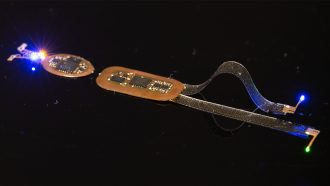
With the help of headsets and backpacks on mice, scientists are using light to switch nerve cells on and off in the rodents’ brains to probe the animals’ social behavior, a new study shows.
These remote control experiments are revealing new insights on the neural circuitry underlying social interactions, supporting previous work suggesting minds in sync are more cooperative, researchers report online May 10 in Nature Neuroscience.
The new devices rely on optogenetics, a technique in which researchers use bursts of light to activate or suppress the brain nerve cells, or neurons, often using tailored viruses to genetically modify cells so they respond to illumination (SN: 1/15/10). Scientists have used optogenetics to probe neural circuits in mice and other lab animals to yield insights on how they might work in humans (SN: 10/22/19).
Optogenetic devices often feed light to neurons via fiber-optic cables, but such tethers can interfere with natural behaviors and social interactions. While scientists recently developed implantable wireless optogenetic devices, these depend on relatively simple remote controls or limited sets of preprogrammed instructions.
These new fully implantable optogenetic arrays for mice and rats can enable more sophisticated research. Specifically, the researchers can adjust each device’s programming during the course of experiments, “so you can target what an animal does in a much more complex way,” says Genia Kozorovitskiy, a neurobiologist at Northwestern University in Evanston, Ill.
These head-mounted and back-mounted devices are battery-free, wirelessly powered by the same high-frequency radio waves used to remotely control the intensity, duration and timing of the light pulses. The prototypes also allow scientists to simultaneously control four different neural circuits in an animal, thanks to LEDs that emit four hues — blue, green, yellow and red — instead of just one.
In experiments with mice, Kozorovitskiy and colleagues used the devices to target the prefrontal cortex, a part of the brain linked with decision making and other complex behaviors. When the team delivered similar patterns of neural stimulation in this area to pairs or trios of mice, the rodents groomed and sniffed companions with whom their neurons were in sync more often than ones with whom they were out of sync. The findings support previous research suggesting this kind of synchrony between minds can boost social behavior, “particularly cooperative interactions,” Kozorovitskiy says.
The widely available wireless technology used in this work, the same now used in contactless payment with credit cards, could allow broad adoption across the neuroscience community “without extensive specialized hardware,” says neurotechnologist Philipp Gutruf at the University of Arizona at Tucson, who did not take part in this research. That “means that we might see these devices in many labs in the near future, enabling new discoveries.” The insights gained on the nervous system from such research, he says, may in turn “inform better diagnostics and therapeutics in humans.”
 Horned dinosaurs’ weapons evolved to handle the forces of combat
  Artemis II results show how much science people can do at the moon
  Crossword: Time lines
  Many American diets may not include enough of this essential nutrient
  A telling hole in a Neandertal bone hints at a bitter end
  Brain implants are helping people who’ve lost their voice
  Inside the New York ‘time machine’ racing to save a century of sound and film
  Two Summits in Bangkok: IMF/World Bank and Finance Ministers Inside, the People’s Assembly Outside
  CHINA: ‘My Sister Has Been in a Chinese Prison for Eight Years Because I Exercised My Freedom of Speech’
  COP17: The world has a plan to save nature. Is it working?