
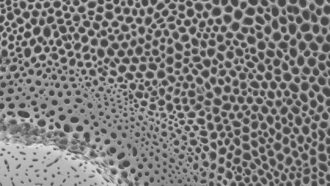
Sea urchin skeletons may owe some of their strength to a common geometric design.
Components of the skeletons of common sea urchins (Paracentrotus lividus) follow a similar pattern to that found in honeycombs and dragonfly wings, researchers report in the August Journal of the Royal Society Interface. Studying this recurring natural order could inspire the creation of strong yet lightweight new materials.
Urchin skeletons display “an incredible diversity of structures at the microscale, varying from fully ordered to entirely chaotic,” says marine biologist and biomimetic consultant Valentina Perricone. These structures may help the animals maintain their shape when faced with predator attacks and environmental stresses.
While using a scanning electron microscope to study urchin skeleton tubercules — sites where the spines attach that withstand strong mechanical forces — Perricone spotted “a curious regularity.” Tubercules seem to follow a type of common natural order called a Voronoi pattern, she and her colleagues found.
Using math, a Voronoi pattern is created by a process that divides a region into polygon-shaped cells that are built around points within them called seeds (SN: 9/23/18). The cells follow the nearest neighbor rule: Every spot inside a cell is nearer to that cell’s seed than to any other seed. Also, the boundary that separates two cells is equidistant from both their seeds.
A computer-generated Voronoi pattern had an 82 percent match with the pattern found in sea urchin skeletons. This arrangement, the team suspects, yields a strong yet lightweight skeletal structure. The pattern “can be interpreted as an evolutionary solution” that “optimizes the skeleton,” says Perricone, of the University of Campania “Luigi Vanvitelli” in Aversa, Italy.
Urchins, dragonflies and bees aren’t the only beneficiaries of Voronoi architecture. “We are developing a library of bioinspired, Voronoi-based structures” that could “serve as lightweight and resistant solutions” for materials design, Perricone says. These, she hopes, could inspire new developments in materials science, aerospace, architecture and construction.
 Horned dinosaurs’ weapons evolved to handle the forces of combat
  Artemis II results show how much science people can do at the moon
  Crossword: Time lines
  Many American diets may not include enough of this essential nutrient
  A telling hole in a Neandertal bone hints at a bitter end
  Brain implants are helping people who’ve lost their voice
  Gaza: 340 children killed despite ceasefire agreement – UNICEF
  Security Council LIVE: Sudan’s war spreads as drones and hunger take a deadly toll
  Guterres urges faster action and financing to stop biodiversity loss