
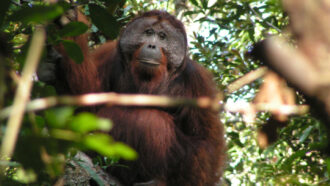
Human language, in its many current forms, may owe an evolutionary debt to our distant ape ancestors who sounded off in groups of scattered individuals.
Wild orangutans’ social worlds mold how they communicate vocally, much as local communities shape the way people speak, researchers report March 21 in Nature Ecology & Evolution. This finding suggests that social forces began engineering an expanding inventory of communication sounds among ancient ancestors of apes and humans, laying a foundation for the evolution of language, say evolutionary psychologist Adriano Lameira, of the University of Warwick in England, and his colleagues.
Lameira’s group recorded predator-warning calls known as “kiss-squeaks” — which typically involve drawing in breath through pursed lips — of 76 orangutans from six populations living on the islands of Borneo and Sumatra, where they face survival threats (SN: 2/15/18). The team tracked the animals and estimated their population densities from 2005 through 2010, with at least five consecutive months of observations and recordings in each population. Analyses of recordings then revealed how much individuals’ kiss-squeaks changed or remained the same over time.
Orangutans in high-density populations, which up the odds of frequent social encounters, concoct many variations of kiss-squeaks, the researchers report. Novel reworkings of kiss-squeaks usually get modified further by other orangutans or drop out of use in crowded settings, they say.
In spread-out populations that reduce social mingling, these apes produce relatively few kiss-squeak variants, Lameira’s group finds. But occasional kiss-squeak tweaks tend to catch on in their original form in dispersed groups, leading to larger call repertoires than in high-density populations.
Low-density orangutan groups — featuring small clusters of animals that occasionally cross paths — might mirror the social settings of human ancestors. Ancient apes and hominids also lived in dispersed groups that could have bred a growing number of ways to communicate vocally, the researchers suspect.
 A quantum computing feat brings the ‘megaquops’ era a step closer
  AI can give you your voice back
  These tiny snakes cartwheel to escape danger
  Japan’s sample return mission to Phobos may also collect some Mars dust
  Horned dinosaurs’ weapons evolved to handle the forces of combat
  Artemis II results show how much science people can do at the moon
  Yemen war continues to force families from homes amid hunger and disease
  Afghan Women Defy Taliban Restrictions Through Online Protests
  Food Insecurity and Child Malnutrition Worsen in Afghanistan Despite Strong Agricultural Season
  People Who Choose to End Their Lives