
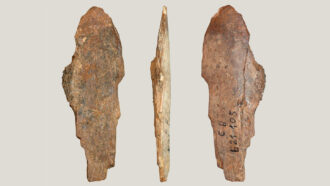
Discoveries in a Moroccan cave have provided a rare look at how Stone Age people may have turned animal skins into clothing.
Bone tools, including hide scrapers and stone-tool sharpeners, were unearthed in Morocco’s Contrebandiers cave, say archaeologist Emily Hallett and colleagues. Dating of sediment, burned stones and animal teeth excavated there shows that the tools are around 90,000 to 120,000 years old, the scientists report September 16 in iScience.
“Prior to major successful dispersals out of Africa and into Eurasia, Homo sapiens [were] making tools for various specialized functions, and those behaviors would have aided them [in] new environments,” says Hallett, of the Max Planck Institute for the Science of Human History in Jena, Germany. Different types of bone tools from around the time of the Moroccan finds have been unearthed at a handful of other African sites, though uses for many of those items remain unclear. Researchers have largely focused on an explosion of African bone tool styles that appeared around 44,000 years ago, after human expansions into Eurasia.
Of 62 bone implements from the cave, seven were hide scrapers. These tools were crafted from pieces of antelope or wild cattle ribs that were split in half lengthwise and worked into a flat, spatula-like shape. Short, deep grooves and polish on these items resulted from scraping animal hides, the researchers say.
The team unearthed the tools along with skinned animals’ bones. Patterns of stone-tool incisions on limb and jaw bones of sand foxes, golden jackals and wildcats resulted from detaching skin at the paws and pulling it over the head in one piece, providing evidence for the way the bone hide scrapers were used, the scientists say.
Ancient humans could have put hides presumably worked into leather or pelts to various uses, though clothing seems especially likely, Hallett says. DNA evidence of body lice origins suggests that people began wearing clothes at least 190,000 years ago (SN: 4/20/10).
 AI can give you your voice back
  These tiny snakes cartwheel to escape danger
  Japan’s sample return mission to Phobos may also collect some Mars dust
  Horned dinosaurs’ weapons evolved to handle the forces of combat
  Artemis II results show how much science people can do at the moon
  Crossword: Time lines
  As El Niño Returns, East Africa’s Urban Poor Brace for Heavy Rains
  Hunger is ‘an avoidable tragedy’ in a world of plenty: Türk
  UN condemns deadly wave of drone strikes in war-torn Sudan