
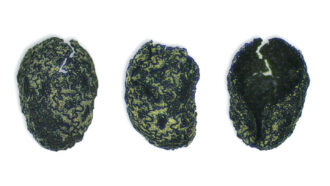
Ancient North Americans started using tobacco around 12,500 to 12,000 years ago, roughly 9,000 years before the oldest indications that they smoked the plant in pipes, a new study finds.
This discovery replaces the pipe-smoking report as the oldest direct evidence for the human use of tobacco anywhere in the world.
Excavations at the Wishbone site in Utah’s Great Salt Lake Desert uncovered four charred seeds of wild tobacco plants in a small fireplace, say archaeologist Daron Duke of Far Western Anthropological Research Group in Henderson, Nev., and colleagues.
Those seeds, three of which the scientists radiocarbon dated, likely came from plants gathered on foothills or mountains located 13 kilometers or more from the Wishbone area, Duke’s team reports October 11 in Nature Human Behavior.
The site was located in a sprawling marshland at the time of its occupation. Finds in and around the fireplace include bones of ducks and other waterfowl, a long, intact stone point and another point broken in two, a bone implement and seeds of several edible wetland plants.
It’s unclear how ancient North American hunter-gatherers used the tobacco, Duke says. Wads of tobacco leaves, stems and other plant fibers may have been twisted into balls and chewed or sucked, with attached seeds spit out or discarded. Ancestors of Pueblo people in what’s now Arizona chewed wild tobacco between around 1,000 and 2,000 years ago. Tobacco smoking can’t be ruled out at the Wishbone site, Duke adds.
The earliest evidence of domesticated tobacco, which comes from South America, dates to only about 8,000 years ago (SN: 10/29/18). Duke suspects various ancient American populations independently tamed the plant at different times. “Certain groups wound up domesticating particular [tobacco] species, typically alongside food crops,” he suggests.
 This Halloween, amateur astronomers may be in for a dwarf planet treat
 ‘Exhumed’ recounts the true story of America’s first vampire
 NASA’s Swift telescope will face a fiery demise after a failed rescue
 A proof-of-concept test can spot bladder cancer in urine
 Seabirds get jet lag, too — and it can throw them a bit off course
 Some of the world’s biggest bats are getting smaller
 Ukraine: Oleshky ceasefire offers ‘hope’ for civilians as attacks on aid vehicles continue
 World News in Brief: 300,000 displaced in Lebanon, Türk ‘deeply concerned’ over Novaya Gazeta closure, $50 million refugee appeal, World Cities Day
 DR Congo: Hunger deepens for millions amid conflict, Ebola and climate shocks
 African Athletes Should be Free to be Themselves