
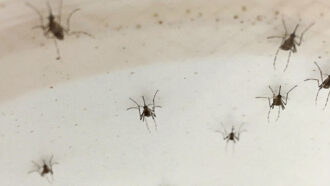
Some mosquito-borne viruses turn mice into alluring mosquito bait.
Mice infected with dengue or Zika viruses — and people infected with dengue — emit a flowery, orange-smelling chemical that tempts hungry mosquitoes, researchers report June 30 in Cell. In mice, the infections spur the growth of skin-inhabiting bacteria that make the chemical, drawing in bloodsucking Aedes aegypti mosquitoes that could then transmit the viruses to new hosts, including humans.
Previous studies showed that other mosquito species prefer to feed on animals carrying the parasite that causes malaria (SN: 2/9/17). But it was unknown whether the same was true for viruses such as dengue or Zika, says Gong Cheng, a microbiologist at Tsinghua University in Beijing.
The chemical acetophenone — which to humans smells like orange blossom — may be that lure. Mice infected with dengue or Zika viruses give off approximately 10 times more acetophenone and attract more mosquitoes than uninfected animals, Cheng and colleagues found. People infected with dengue similarly release more of the chemical than healthy people. Samples of odors taken from the armpits of infected people also created potent mosquito magnets when smeared on filter paper attached to a volunteer’s palm.
Acetophenone typically comes from bacteria. Researchers found that Bacillus bacteria on mice were the likely culprits producing the chemical. An infection stops mice from making an antimicrobial protein called RELMα, allowing the acetophenone-emitting microbes to flourish.
But a component of some acne medications can bring back RELMα in mice, the team found. Infected animals fed a derivative of vitamin A called isotretinoin produced less acetophenone and become less attractive mosquito targets.
It’s possible that giving people isotretinoin could help reduce virus transmission among people by hiding infected people from the bloodsucking insects, Cheng says. He and colleagues are planning to test the strategy in Malaysia, where dengue circulates.
 Horned dinosaurs’ weapons evolved to handle the forces of combat
  Artemis II results show how much science people can do at the moon
  Crossword: Time lines
  Many American diets may not include enough of this essential nutrient
  A telling hole in a Neandertal bone hints at a bitter end
  Brain implants are helping people who’ve lost their voice
  WHO scales up Ebola readiness in 22 countries across three continents
  Ukraine: Civilian casualty rates among ‘deadliest’ in years, as energy attacks intensify
  As disasters mount, next UN climate summit faces a test of trust
  Gaza: 340 children killed despite ceasefire agreement – UNICEF