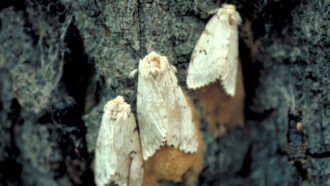
A menacing pest just became a bit less problematic, at least socially, after getting an update to its common name. Lymantria dispar is an invasive insect previously known as the gypsy moth — a label that contains an ethnic slur. On March 2, the Entomological Society of America renamed L. dispar the spongy moth.
The updated term is a nod to the moth’s porous egg casing. It was selected through ESA’s Better Common Names Project, after hundreds of new name suggestions for L. dispar poured in from the public after the society retired the old name last July (SN: 8/25/21). ESA elected the moth for a rebrand primarily due to its frequent presence in conversation. Now, entomologists and gardeners alike can discuss the pervasive pest without using pejorative language. It’s one action in a larger mission to decolonize science, which aims, in part, to create a more diverse and inclusive atmosphere in science.
“Decolonizing science is actually a really broad process,” says Jessica Ware, the president of ESA and an entomologist at the American Museum of Natural History. “Addressing common names is just one piece of that.”
This is the first rebranding that the project has tackled. It will continue to gather input on insect names that perpetuate stereotypes or contain insulting references. Ware says dozens of species are waiting to be addressed, such as the Asian giant hornet (Vespa mandarinia). And insects aren’t the only offenders: Birds, mammals and plants often have names referencing racial or ethnic slurs or white colonizers.
 AI can give you your voice back
  These tiny snakes cartwheel to escape danger
  Japan’s sample return mission to Phobos may also collect some Mars dust
  Horned dinosaurs’ weapons evolved to handle the forces of combat
  Artemis II results show how much science people can do at the moon
  Crossword: Time lines
  As El Niño Returns, East Africa’s Urban Poor Brace for Heavy Rains
  Hunger is ‘an avoidable tragedy’ in a world of plenty: Türk
  UN condemns deadly wave of drone strikes in war-torn Sudan