
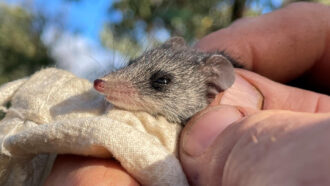
Few marsupials have gone from miraculous survival to the brink of extinction as quickly as the Kangaroo Island dunnart.
In 2019 and 2020, devastating fires burned nearly 10 million hectares of southeastern Australia. The flames threatened hundreds of species with extinction, but the Kangaroo Island dunnart (Sminthopsis aitkeni) — which already numbered less than 500 before the fires — seemed to be one that defied expectations in the aftermath (SN: 3/9/21).
But now these rare creatures may be more at risk than ever, researchers say June 16 in Scientific Reports. The danger, as domestic as it sounds, is getting eaten by a cat.
As of 2008, invasive feral cats had contributed to at least 13 percent of extinctions worldwide. That’s one reason the government has been euthanizing cats on Kangaroo Island for years. The scientists who conducted the dunnart study knew all this — but when they studied the remains of cats euthanized in 2020, they were still surprised by what they saw: Seven out of 86 cats had recently dined on dunnart.
“We were not expecting to find so many,” says Louis Lignereux, a field researcher at the University of Adelaide School of Animal and Veterinary Science. It’s particularly bad news, he says, if you think of what was in the cats as only a snapshot of what they ate in the last 36 hours. Taking that into account, those seven cats alone could have eaten enough to wipe out the Kangaroo Island dunnart within a few months, if they had survived — and there are hundreds of other cats on the island.
A small habitat makes the dunnarts especially vulnerable. It’s like putting all your eggs in one basket, Lignereux says. Since the fires, the Kangaroo Island dunnart is thought to now live in an area about one-tenth of the size of Manhattan (SN: 1/13/20).
“If something happened to this spot,” he says, “then [the dunnart] is gone forever.”
 Horned dinosaurs’ weapons evolved to handle the forces of combat
  Artemis II results show how much science people can do at the moon
  Crossword: Time lines
  Many American diets may not include enough of this essential nutrient
  A telling hole in a Neandertal bone hints at a bitter end
  Brain implants are helping people who’ve lost their voice
  COP17: The world has a plan to save nature. Is it working?
  Flour sacks turned flood barriers: Gaza faces another winter without safe shelter
  WHO scales up Ebola readiness in 22 countries across three continents
  Ukraine: Civilian casualty rates among ‘deadliest’ in years, as energy attacks intensify