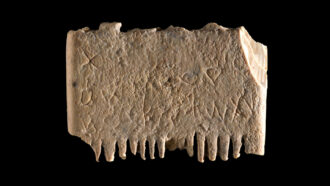
Engraved into the side of a nearly 4,000-year-old ivory comb is a simple wish: Get these lice out of my hair.
This faint inscription, written in the early language of the ancient Canaanites, represents the earliest known instance of a complete sentence written using a phonetic alphabet, says archaeologist Yosef Garfinkel of the Hebrew University of Jerusalem.
The writing system of the Canaanites, who lived in a region in the eastern Mediterranean called the Levant until around 2,000 years ago, later served as a major basis for many modern alphabets (SN: 7/27/17). That makes the comb “the most important object I’ve ever found during an excavation,” says Garfinkel. The research was published November 9 in the Jerusalem Journal of Archaeology.
The Canaanites were a cultural group that traded widely across the Mediterranean. Few of their written records have survived, so most of what researchers know about them come from other documents, such as the Old Testament.
The comb was the unearthed in 2016 among the ruins of the ancient city of Lachish in present-day Israel. Years later, when the comb was sent to a lab to search for traces of lice, someone noticed faint symbols etched on the side. A closer look revealed that the symbols spelled out the sentence, “May this tusk root out the lice of the hair and the beard,” Garfinkel and colleagues report November 9 in the Jerusalem Journal of Archaeology.
The discovery may offer a glimpse into the life of one of Lachish’s wealthy denizens. The fact that the sentence refers to a beard suggests it belonged to an elite man, Garfinkel says, since elephant ivory was an expensive good that had to be imported from Egypt.
The plea against lice is “so human,” says Garfinkel, who notes that other writings from the time tend to center around royal accomplishments or religion. It also appears that the comb was able to fulfill its purpose, at least somewhat. Between the teeth, the researchers found the ancient remains of a louse.
 Many American diets may not include enough of this essential nutrient
  A telling hole in a Neandertal bone hints at a bitter end
  Brain implants are helping people who’ve lost their voice
  Can math stay human in the age of AI?
  Tiny implants can use the body itself to talk to each other
  Voyager 1 is nearly one light-day from Earth. What’s out there?
  Could your brain data be used against you? UN calls for limits on neurotechnology
  Ukraine: Critical health supplies destroyed in ongoing Russian attacks
  AI, green energy and economic transitions risk leaving vulnerable communities behind, UN warns
  Afghanistan faces record hunger levels amid rampant rights violations