
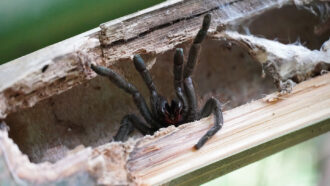
Meet “bambootula.” This newfound tarantula gets its nickname from the tall, stiff-shafted grass in which it makes a home in northern Thailand.
Taksinus bambus, as the spider is officially known, “is the world’s first tarantula with a biology tied to bamboo,” says arachnologist Narin Chomphuphuang of Khon Kaen University in Thailand.
Bamboo stems, or culms, give the tarantula ready-made burrows and nests. But T. bambus lacks the tools to bore into culms, so it relies on natural forces or animals such as borer beetles and rodents to create openings, Chomphuphuang and colleagues report January 4 in ZooKeys. Once inside, bambootula builds a silk “retreat tube” that keeps the spider secure and helps it move around easily.
Chomphuphuang was introduced to the tarantula by JoCho Sippawat, a popular wildlife YouTuber who discovered it when cutting bamboo in the forest near his home. Chomphuphuang’s team confirmed the spider belonged to a new genus and species based on the size and shape of its reproductive organs. It’s the first time in 104 years that anyone has turned up a new genus of tarantula in Asia, the researchers say.
Habitat type also was key to confirming the spider’s novelty, Chomphuphuang says. Other Asian tree-dwelling tarantulas are found in habitats unlike where bambootula showed up — a bamboo forest about 1,000 meters above sea level.
Cornell University arachnologist Linda Rayor isn’t too surprised by the find. So far, some 49,000 species of spiders are known to science and new ones are frequently discovered (SN: 2/4/16). Researchers estimate that 1 in every 3 to 5 spider species alive has yet to be found and named. Anyone can find a new spider, she says, including “local people looking and exploring and watching things.”
But “few people realize how much wildlife in Thailand is still undocumented,” Chomphuphuang says. Forests now cover only about one-third of the country. It’s important for scientists to keep looking for new species in such areas, he says, so the animals can be studied — and, where needed, protected.
 These tiny snakes cartwheel to escape danger
  Japan’s sample return mission to Phobos may also collect some Mars dust
  Horned dinosaurs’ weapons evolved to handle the forces of combat
  Artemis II results show how much science people can do at the moon
  Crossword: Time lines
  Many American diets may not include enough of this essential nutrient
  As El Niño Returns, East Africa’s Urban Poor Brace for Heavy Rains
  Hunger is ‘an avoidable tragedy’ in a world of plenty: Türk
  UN condemns deadly wave of drone strikes in war-torn Sudan
  Guterres honours Indonesian troops who paid ‘ultimate sacrifice’