
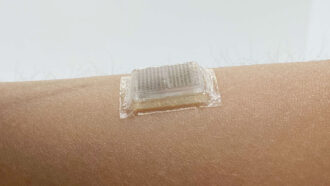
Picture a smartwatch that doesn’t just show your heart rate, but a real-time image of your heart as it beats in your chest. Researchers may have taken the first step down that road by creating a wearable ultrasound patch — think of a Band-Aid with sonar — that provides a flexible way to see deep inside the body.
Ultrasound, which maps tissues and fluids by recording how sound waves bounce off them, can help doctors examine organs for damage, diagnose cancer or even track bacteria (SN: 1/3/18). But most ultrasound machines aren’t portable, and the wearable ones either struggle to spot details or can be used for only short periods.
The new patch can work for up to 48 hours straight — even while the user is doing something active, like exercising. And the miniature device sees just as well as a more unwieldy hospital machine, researchers report in the July 29 Science.
“This is just the beginning,” says Xuanhe Zhao, a mechanical engineer at MIT. His team plans to make the patch wireless and able to interface with a user’s phone, which could then show the ultrasound signals as 3-D images.
The medical possibilities range wide. Stick a patch over a person’s heart, and the frequent images it takes could help predict heart attacks and blood clots potentially months before disaster hits, explains Aparna Singh, a biomedical engineer at Columbia University. Placed on a COVID-19 patient, the patch — which is only about the size of a quarter — could be an easy way to catch lung problems as they develop.
“This also has a huge potential to be available for developing countries,” where limited access to hospitals can make monitoring patients difficult, Singh says. The patch costs about $100 to make. One of the researchers’ next steps will be to try to make the device cheaper.
 Horned dinosaurs’ weapons evolved to handle the forces of combat
  Artemis II results show how much science people can do at the moon
  Crossword: Time lines
  Many American diets may not include enough of this essential nutrient
  A telling hole in a Neandertal bone hints at a bitter end
  Brain implants are helping people who’ve lost their voice
  WHO scales up Ebola readiness in 22 countries across three continents
  Ukraine: Civilian casualty rates among ‘deadliest’ in years, as energy attacks intensify
  As disasters mount, next UN climate summit faces a test of trust
  Gaza: 340 children killed despite ceasefire agreement – UNICEF