
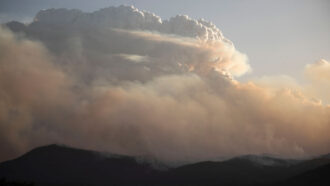
A massive tower of smoke generated by Australian wildfires in late 2019 set a new record for the loftiest and largest fire-spawned thunderstorms ever measured. It also may represent a new class of volcanic-scale “pyrocumulonimbus” events, scientists said in an online news conference December 11 at the American Geophysical Union’s fall meeting.
A particularly intense spate of fires in southeastern Australia during the country’s 2019–2020 “Black Summer” wildfire season led to a “super outbreak” of 32 separate pyrocumulonimbus, or pyroCB, events from December 29 to December 31 (SN: 3/4/20) . The resulting plume of smoke sent aloft was so massive that it rose up to 35 kilometers into the atmosphere, high into the stratosphere, well above the heights that jet planes fly (SN: 6/15/20). Combined with a second large plume on January 4, they injected three times more aerosol particles into the stratosphere than any previously recorded pyroCb event.
Such a long-lasting, intense event “was like nothing we’ve seen before,” eclipsing the previous record-holder, a vast fire cloud that formed over the Pacific Northwest in 2017, said David Peterson, a meteorologist at the U.S. Naval Research Laboratory in Monterey, Calif. The Australian outbreak “exceeded this previously unprecedented event on almost every level.” In terms of sheer number of aerosols sent into the stratosphere, the Australian plumes were on par with the strongest volcanic eruptions in the last 25 years.
What impact these particles have on atmosphere, weather patterns and the ozone layer is still unclear. Scientists detected traces of the 2017 plume for up to 10 months; particles from the Black Summer plumes are still lingering, Peterson said. His work will appear in an upcoming issue of npj Climate and Atmospheric Science.
Whether these events will become increasingly common as the climate warms also isn’t clear. PyroCb clouds require both very large and intensely hot fires and thunderstorm-enabling conditions, including moisture, several kilometers up in the atmosphere. Those conditions could become more common in some regions due to climate change.
 A nanoparticle revealed the tiny impact of a single gas atom
  Was van Gogh’s ‘The Starry Night’ a flight of fancy or a real sky?
  This ‘living drug’ could change the course of autoimmune disease
  AI could turn scientific papers into research assistants
  A lifesaving medication is not behind the drop in U.S. overdose deaths
  Peek into hidden worlds revealed by the 2026 Nikon Small World contest
  ‘Connect the dots’ between street protests and global turmoil, urges Guterres
  DR Congo: Ebola responders under pressure as outbreak expands