
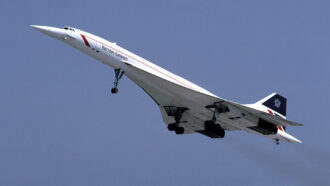
Sonic booms can be particularly annoying in cities, where tall buildings and narrow streets boost noise levels and cause the noise to linger, new research shows.
Planes traveling faster than the speed of sound create a shock wave in the form of a short-lived boom. These intense sonic booms have harmed people’s hearing, shattered windows and caused other physical damage to homes and buildings (SN: 12/19/64). NASA is developing aircraft with more subdued booms, but the sound won’t go away entirely. Even modest booms might be a problem in cities.
“The noise levels induced by these lower-level booms are still expected to be significant,” says study coauthor Didier Dragna of the École Centre de Lyon in France.
Dragna and colleagues simulated booms from supersonic planes passing over buildings. For a building standing out in the open, boom-induced noise lasted about a tenth of a second. Sound reflecting from the building boosts noise levels slightly for the side facing an approaching plane and reduces it on the side facing away.
For packed cityscapes, however, noise reflected from buildings following a sonic boom fills in the regions between buildings and resonates like the echoes of a hand clap in an empty hall, the team reports in the June Journal of the Acoustical Society of America. Their simulations showed that even after the initial boom has passed the noise persists for several seconds, creating what Dragna describes as a thunderous, window- and door-rattling rumble.
Civilian aircraft in the United States are generally prohibited from traveling over land at supersonic speeds. But NASA will begin test flights of its “quiet” X-59 supersonic aircraft over cities in 2024. “It is important to predict what will be the noise levels and the annoyance due to these supersonic planes,” Dragna says.
 How brain implants turn thoughts into speech
  Roller coaster safety is a matter of science
  After the dinosaurs died, the massive ‘D. rex’ fungus ruled the woods
  Volcanoes lurk behind the scenes of human history
  Claude helped plan risky bird flu research. What did the AI add?
  The human voice
  World News in Brief: ‘No safe place in Ukraine’, IAEA calls for Iran nuclear inspections, Kenya hosts thousands of Ethiopians fleeing clashes
  Kenya: 20 Ebola contacts released from quarantine
  Record carbon dioxide levels will impact us for centuries, says UN weather agency