
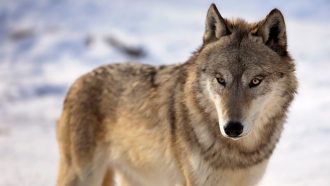
Gray wolves help keep North America’s deer populations in check, and by doing so, may provide an added benefit for people: curbing deer-vehicle collisions. In Wisconsin counties where wolf populations returned, the number of such collisions dropped in each area by 24 percent on average, scientists report online May 24 in the Proceedings of the National Academy of Sciences.
Economist Jennifer Raynor and colleagues analyzed data on wolf populations, deer populations and deer-vehicle collisions for 63 counties in Wisconsin from 1988 to 2010. In the 29 counties that had wolves, the predators thinning deer populations contributed about a 6 percent reduction in deer-vehicle collisions. The rest of the decrease, the team proposes, was due to the wolves’ presence near roads, which they use as travel corridors, creating a so-called “landscape of fear” that keeps deer away. That suggests that recreational hunters wouldn’t replicate wolves’ impact by simply culling the same number of deer, the researchers say.
The average drop of 38 deer-vehicle collisions per year in counties with wolves translates to an estimated $10.9 million in savings each year across the state, the team found. For comparison, the state paid about $3 million over the last 35 years to compensate for wolf damages. There may be other economic benefits not measured by the study such as reductions in damage to agriculture by deer and in Lyme disease frequency, says Raynor of Wesleyan University in Middletown, Conn (SN: 11/15/18).
“The most interesting thing to me about choosing Wisconsin as a case study is that this is a human-dominated landscape,” Raynor says. Similar analyses could guide management decisions where potential wolf habitats overlap with heavily populated areas, such as in the northeastern United States, she and colleagues propose.
 Was the ‘American cheetah’ a cheetah at all?
  AI agents aren’t ready to replace humans in behavioral research
  A culprit for corrosion may have been operating under our noses
  New Hubble images reveal a bizarre decagon over Saturn’s south pole
  A massive study unveils the genetic underpinnings of fibromyalgia
  The universe may have been building rocky planets almost from the start
  Coordinated action on clean air and climate change can net $15 for every dollar spent
  Human rights chief Türk renews call for end to spiralling Sudan war
  AI: Türk urges action before it becomes an ‘existential risk to humanity’
  UNGA 81: A United Nations at a Turning Point