
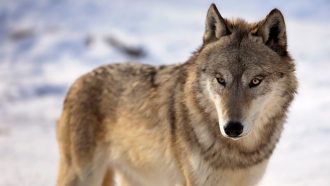
Gray wolves help keep North America’s deer populations in check, and by doing so, may provide an added benefit for people: curbing deer-vehicle collisions. In Wisconsin counties where wolf populations returned, the number of such collisions dropped in each area by 24 percent on average, scientists report online May 24 in the Proceedings of the National Academy of Sciences.
Economist Jennifer Raynor and colleagues analyzed data on wolf populations, deer populations and deer-vehicle collisions for 63 counties in Wisconsin from 1988 to 2010. In the 29 counties that had wolves, the predators thinning deer populations contributed about a 6 percent reduction in deer-vehicle collisions. The rest of the decrease, the team proposes, was due to the wolves’ presence near roads, which they use as travel corridors, creating a so-called “landscape of fear” that keeps deer away. That suggests that recreational hunters wouldn’t replicate wolves’ impact by simply culling the same number of deer, the researchers say.
The average drop of 38 deer-vehicle collisions per year in counties with wolves translates to an estimated $10.9 million in savings each year across the state, the team found. For comparison, the state paid about $3 million over the last 35 years to compensate for wolf damages. There may be other economic benefits not measured by the study such as reductions in damage to agriculture by deer and in Lyme disease frequency, says Raynor of Wesleyan University in Middletown, Conn (SN: 11/15/18).
“The most interesting thing to me about choosing Wisconsin as a case study is that this is a human-dominated landscape,” Raynor says. Similar analyses could guide management decisions where potential wolf habitats overlap with heavily populated areas, such as in the northeastern United States, she and colleagues propose.
 These tiny snakes cartwheel to escape danger
  Japan’s sample return mission to Phobos may also collect some Mars dust
  Horned dinosaurs’ weapons evolved to handle the forces of combat
  Artemis II results show how much science people can do at the moon
  Crossword: Time lines
  Many American diets may not include enough of this essential nutrient
  Protecting Earth’s fragile biodiversity takes spotlight at Armenia talks
  Gaza: Funding cuts leave half a million without food assistance
  Afro-Brazilian Religious Communities Face Mounting Discrimination Amid the Climate Crisis