
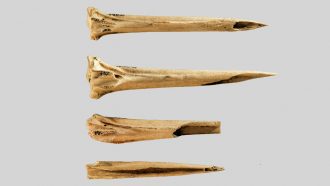
Ancient tattooing tools are tough to find or even recognize as implements for creating skin designs. But new microscopic studies of two turkey leg bones with sharpened ends indicate that Native Americans used these items to make tattoos between around 5,520 and 3,620 years ago.
These pigment-stained bones are the world’s oldest known tattooing tools, say archaeologist Aaron Deter-Wolf of the Tennessee Division of Archaeology in Nashville and his colleagues. The find suggests that Native American tattoo traditions in eastern North America extend back more than a millennium earlier than previously thought (SN: 3/4/19). Ötzi the Iceman, who lived around 5,250 years ago in Europe, displays the oldest known tattoos (SN: 1/13/16), but researchers haven’t found any of the tools used to make the Iceman’s tattoos.
Excavations in 1985 revealed these turkey bones and other elements of a probable tattoo kit in a man’s burial pit at Tennessee’s Fernvale site, the researchers report in the June Journal of Archaeological Science: Reports. Damage on and near the tips of the two turkey leg bones resembles distinctive wear previously observed on experimental tattooing tools made from deer bones, Deter-Wolf’s team says. In that research, tattooed lines in fresh slabs of pig skin were produced by a series of punctures with tools that had tips coated in a homemade ink. Experimental tattooing left ink remnants several millimeters from tools’ tips, a pattern also seen with red and black pigment residues on the Fernvale tools.
Two turkey wing bones found in the same Fernvale grave display microscopic wear and pigment residues that likely resulted from applying pigment during tattooing, the scientists say. Pigment-stained seashells in the grave may have held solutions into which tattooers dipped those tools.
 These tiny snakes cartwheel to escape danger
  Japan’s sample return mission to Phobos may also collect some Mars dust
  Horned dinosaurs’ weapons evolved to handle the forces of combat
  Artemis II results show how much science people can do at the moon
  Crossword: Time lines
  Many American diets may not include enough of this essential nutrient
  Protecting Earth’s fragile biodiversity takes spotlight at Armenia talks
  Gaza: Funding cuts leave half a million without food assistance
  Afro-Brazilian Religious Communities Face Mounting Discrimination Amid the Climate Crisis