
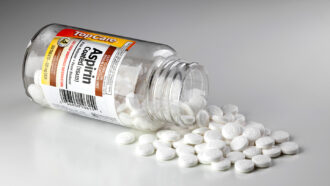
Aspirin and Birth Defects: Fetal Cell Inhibition — Science News, October 2, 1971
Although aspirin has triggered defects in rat and mice fetuses, the evidence suggesting aspirin taken by women during pregnancy can harm their offspring has been circumstantial at best. Now, however … [evidence shows] that aspirin can dramatically arrest the growth of human embryo cells.
Update
Scientists are still sorting out how aspirin and other nonsteroidal anti-inflammatory drugs, collectively known as NSAIDs, affect pregnancy at every stage. Taking NSAIDs during the first trimester is known to increase the risk of miscarriage (SN: 11/5/11, p. 14). In 2020, the U.S. Food and Drug Administration warned that people who are 20 weeks or more into a pregnancy should avoid using NSAIDs altogether because the drugs can cause rare but serious kidney problems as well as heart problems for fetuses. However, exceptions can be made for pregnant people at risk of preeclampsia (SN: 7/13/91, p. 22), clotting and preterm delivery. In such cases, the FDA recommends that doctors prescribe the lowest effective dose of aspirin.
 These are the first feathers ever found in fossilized dinosaur poop
  See the secret to DNA hookups
  Meet the newest living cat species, the first described in 100 years
  This year’s El Niño just broke a record months before it’s expected to peak
  Finally, a true blue rose exists
  First series of adult T. rex footprints hints at its walking speed
  The Takeaway: UN General Assembly debate Day 5
  Lavrov issues call for new Eurasian ‘security architecture’
  Cuba warns against ‘law of the jungle’ as Foreign Minister denounces US pressure
  Saudi Arabia warns Gulf security inseparable from global stability amid regional tensions