
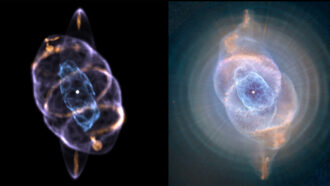
Roughly 3,000 light-years from Earth sits one of the most complex and least understood nebulae, a whirling landscape of gas and dust left in the wake of a star’s death throes. A new computer visualization reveals the 3-D structure of the Cat’s Eye nebula and hints at how not one, but a pair of dying stars sculpted its complexity.
The digital reconstruction, based on images from the Hubble Space Telescope, reveals two symmetric rings around the nebula’s edges. The rings were probably formed by a spinning jet of charged gas that was launched from two stars in the nebula’s center, Ryan Clairmont and colleagues report in the October Monthly Notices of the Royal Astronomical Society.
“I realized there hasn’t been a comprehensive study of the structure of the nebula since the early ’90s,” says Clairmont, an undergraduate at Stanford University. Last year, while a high school student in San Diego, he reached out to a couple of astrophysicists at a scientific imaging company called Ilumbra who had written software to reconstruct the 3-D structure of astronomical objects.
The team combined Hubble images with ground-based observations of light in several wavelengths, which revealed the motions of the nebula’s gas. Figuring out which parts were moving toward and away from Earth helped reveal its 3-D structure.
The team identified two partial rings to either side of the nebula’s center. The rings’ symmetry and unfinished nature suggest they are the remains of a plasma jet launched from the heart of the nebula, then snuffed out before it could complete a full circle. Such jets are usually formed through an interaction between two stars orbiting one another, says Ilumbra partner Wolfgang Steffen, who is based in Kaiserslautern, Germany.
The work won Clairmont a prize at the 2021 International Science and Engineering Fair, an annual competition run by the Society for Science, which publishes Science News. Steffen was skeptical about the tight deadline — when Clairmont reached out, he had just two months to complete the project.
“I said that’s impossible! Not even Ph.D. students or anybody has tried that before,” Steffen says. “He did it brilliantly. He pulled it all off and more than we expected.”
 Artemis II results show how much science people can do at the moon
  Crossword: Time lines
  Many American diets may not include enough of this essential nutrient
  A telling hole in a Neandertal bone hints at a bitter end
  Brain implants are helping people who’ve lost their voice
  Can math stay human in the age of AI?
  Ebola Spread Raises Fresh Urgency for Africa’s Domestic Health Funding
  If the UN COP17 Is Serious About Biodiversity, It Needs to Follow the Money