
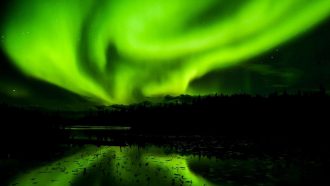
By re-creating the conditions for an aurora in the lab, researchers have confirmed how these bright, shimmery curtains of light form.
The northern lights arise when electrons from space cascade into the upper atmosphere, where they collide with oxygen and nitrogen molecules to paint the sky red and green (SN: 2/7/20). But it has been difficult to discern what, exactly, draws those electrons down toward Earth. For decades, scientists have suspected that electrons ride ripples in Earth’s magnetic field, called Alfvén waves, into the atmosphere, like tiny surfers catching waves to shore. But no satellite has ever directly observed this happening.
A new experiment that accelerated electrons with Alfvén waves offers the first direct evidence that these disturbances in Earth’s magnetic field can push electrons into the atmosphere to cause auroras, plasma physicist James Schroeder and colleagues report online June 7 in Nature Communications.
Ripples called Alfvén waves in Earth’s magnetic field (illustrated as blue squiggles) can sweep electrons (yellow) from space into Earth’s atmosphere to light up auroras — similar to the way ocean waves push surfers to shore.Austin Montelius/University of Iowa
The team filled a 20-meter-long, 1-meter-wide tube with a soup of charged particles, or plasma. Electrical coils created a magnetic field running the length of the chamber. An antenna at one end of the instrument generated its own magnetic field, which essentially plucked the magnetic field lines within the canister to send Alfvén waves rippling through the plasma.
As expected, electrons in the plasma got swept up in the Alfvén waves and accelerated down the chamber. What’s more, “the energy gained per electron per second was similar, in our experiment, to what would be needed out in space to create an aurora,” says Schroeder, of Wheaton College in Illinois.
These results not only confirm the physics behind atmospheric light shows on Earth, Schroeder says. “What’s happening here could very likely be happening at Jupiter, or anywhere else, like Saturn, where we see auroras.”
 These are the first feathers ever found in fossilized dinosaur poop
  See the secret to DNA hookups
  Meet the newest living cat species, the first described in 100 years
  This year’s El Niño just broke a record months before it’s expected to peak
  Finally, a true blue rose exists
  First series of adult T. rex footprints hints at its walking speed
  The Dollar-Gold Standard’s Lingering Demise
  BRAZIL: ‘Resistance Is Intergenerational, and Art Is How Energy Gets Renewed’
  The Global Leaders Network Pushes to Protect Women’s and Children’s Health
  The Takeaway: UN General Assembly debate Day 5