
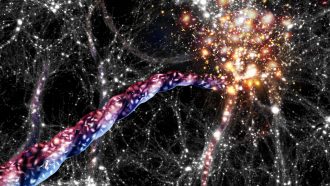
Moons do it, stars do it, even whole galaxies do it. Now, two teams of scientists say cosmic filaments do it, too. These tendrils stretching hundreds of millions of light-years spin, twirling like giant corkscrews.
Cosmic filaments are the universe’s largest known structures and contain most of the universe’s mass (SN: 1/20/14). These dense, slender strands of dark matter and galaxies connect the cosmic web, channeling matter toward galaxy clusters at each strand’s end (SN: 7/5/12).
At the instant of the Big Bang, matter didn’t rotate; then, as stars and galaxies formed, they began to spin. Until now, galaxy clusters were the largest structures known to rotate. “Conventional thinking on the subject said that’s where spin ends. You can’t really generate torques on larger scales,” says Noam Libeskind, cosmologist at the Leibniz Institute for Astrophysics Potsdam in Germany.
So the discovery that filaments spin — at a scale that makes galaxies look like specks of dust — presents a puzzle. “We don’t have a full theory of how every galaxy comes to rotate, or every filament comes to rotate,” says Mark Neyrinck, cosmologist at University of the Basque Country in Bilbao, Spain.
To test for rotation, Neyrinck and colleagues used a 3-D cosmological simulation to measure the velocities of dark matter clumps as the clumps moved around a filament. He and his colleagues describe their results June 3 in a paper posted at arXiv.org and in press with the Monthly Notices of the Royal Astronomical Society. Meanwhile, Libeskind and colleagues searched for rotation in the real universe, they report June 14 in Nature Astronomy. Using the Sloan Digital Sky Survey, the team mapped galaxies’ motions and measured their velocities perpendicular to filaments’ axes.
A computer simulation shows how a cosmic filament twists galaxies and dark matter into a strand of the cosmic web. Filaments pull matter into rotation and toward clusters at their ends, visualized here with “test particles” shaped like comets.
The two teams detected similar rotational velocities for filaments despite differing approaches, Neyrinck says, an “encouraging [indication] that we’re looking at the same thing.”
Next, researchers want to tackle what makes these giant space structures spin, and how they get started. “What is that process?” Libeskind says. “Can we figure it out?”
 These tiny snakes cartwheel to escape danger
  Japan’s sample return mission to Phobos may also collect some Mars dust
  Horned dinosaurs’ weapons evolved to handle the forces of combat
  Artemis II results show how much science people can do at the moon
  Crossword: Time lines
  Many American diets may not include enough of this essential nutrient
  Hunger is ‘an avoidable tragedy’ in a world of plenty: Türk
  UN condemns deadly wave of drone strikes in war-torn Sudan
  Guterres honours Indonesian troops who paid ‘ultimate sacrifice’
  ‘Season of fear’: Escalating Israeli attacks on West Bank olive farmers, deadly strikes on Gaza