

The answer to one of the greatest mysteries of the universe may come down to one of the smallest, and spookiest, particles.
Matter is common in the cosmos. Everything around us — from planets to stars to puppies — is made up of matter. But matter has a flip side: antimatter. Protons, electrons and other particles all have antimatter counterparts: antiprotons, positrons, etc. Yet for some reason antimatter is much rarer than matter — and no one knows why.
Physicists believe the universe was born with equal amounts of matter and antimatter. Since matter and antimatter counterparts annihilate on contact, that suggests the universe should have ended up with nothing but energy. Something must have tipped the balance.
Some physicists think lightweight subatomic particles called neutrinos could point to an answer. These particles are exceedingly tiny, with less than a millionth the mass of an electron (SN: 4/21/21). They’re produced in radioactive decays and in the sun and other cosmic environments. Known for their ethereal tendency to evade detection, neutrinos have earned the nickname “ghost particles.” These spooky particles, originally thought to have no mass at all, have a healthy track record of producing scientific surprises (SN: 10/6/15).
Now researchers are building enormous detectors to find out if neutrinos could help solve the mystery of the universe’s matter. The Hyper-Kamiokande experiment in Hida City, Japan, and the Deep Underground Neutrino Experiment in Lead, S.D., will study neutrinos and their antimatter counterparts, antineutrinos. A difference in neutrinos’ and antineutrinos’ behavior might hint at the origins of the matter-antimatter imbalance, scientists suspect.
Watch the video below to find out how neutrinos might reveal why the universe contains, well, anything at all.
 Horned dinosaurs’ weapons evolved to handle the forces of combat
  Artemis II results show how much science people can do at the moon
  Crossword: Time lines
  Many American diets may not include enough of this essential nutrient
 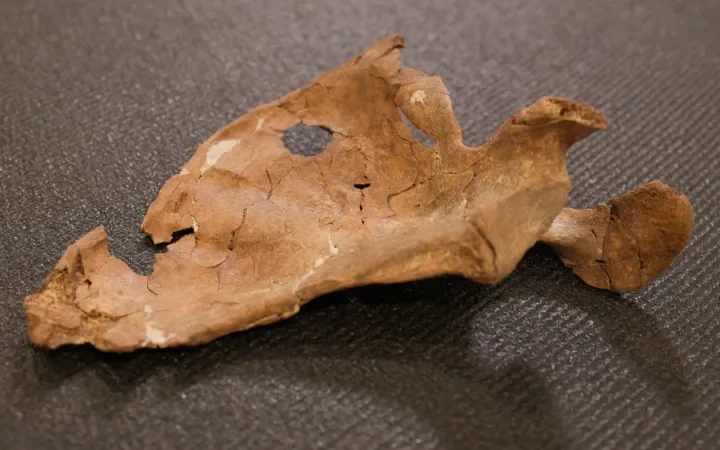 A telling hole in a Neandertal bone hints at a bitter end
  Brain implants are helping people who’ve lost their voice
  Gaza: 340 children killed despite ceasefire agreement – UNICEF
  Security Council LIVE: Sudan’s war spreads as drones and hunger take a deadly toll
  Guterres urges faster action and financing to stop biodiversity loss