
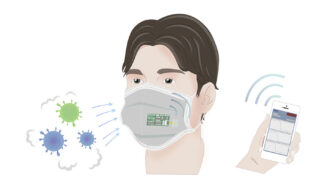
Face masks — the unofficial symbol of the COVID-19 pandemic — are leveling up.
A mask outfitted with special electronics can detect SARS-CoV-2, the virus that causes COVID-19, and other airborne viruses within 10 minutes of exposure, materials researcher Yin Fang and colleagues report September 19 in Matter.
“The lightness and wearability of this face mask allows users to wear it anytime, anywhere,” says Fang, of Tongji University in Shanghai. “It’s expected to serve as an early warning system to prevent large outbreaks of respiratory infectious diseases.”
Sign up for e-mail updates on the latest coronavirus news and research
Airborne viruses can hitch a ride between hosts in the air droplets that people breathe in and out. People infected with a respiratory illness can expel thousands of virus-containing droplets by talking, coughing and sneezing. Even those with no signs of being sick can sometimes pass on these viruses; people who are infected with SARS-CoV-2 can start infecting others at least two to three days before showing symptoms (SN: 3/13/20). So viruses often have a head start when it comes to infecting new people.
Fang and his colleagues designed a special sensor that reacts to the presence of certain viral proteins in the air and attached it to a face mask. The team then spritzed droplets containing proteins produced by the viruses that cause COVID-19, bird flu or swine flu into a chamber with the mask.
The sensor could detect just a fraction of a microliter of these proteins — a cough might contain 10 to 80 times as much. Once a pathogen was detected, the sensor-mask combo sent a signal to the researchers informing them of the virus’s presence. Ultimately, the researchers plan for such signals to be sent to a wearer’s phone or other devices. By combining this technology with more conventional testing, the team says, health care providers and public health officials might be able to better contain future pandemics.
 The human voice
  Why did humans’ brains surpass chimps’? A tiny foe might help explain it
  Eating too much sugar on antibiotics could squash helpful gut bacteria
  Electric stoves could help people with asthma breathe easier
  A nanoparticle revealed the tiny impact of a single gas atom
  Was van Gogh’s ‘The Starry Night’ a flight of fancy or a real sky?
  West Bank: Guterres alarmed as Israel imposes sweeping closures after deadly Hebron attack
  Sudan: Drone strikes killed at least 306 people in three weeks
  Blood brothers: WHO chief joins ENHYPEN to celebrate drive success