
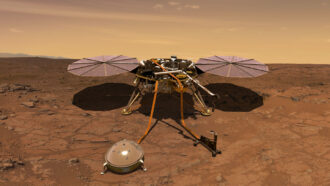
Any Martians out there should learn to duck and cover.
On May 4, the Red Planet was rocked by a roughly magnitude 5 temblor, the largest Marsquake detected to date, NASA’s Jet Propulsion Laboratory in Pasadena, Calif., reports. The shaking lasted for more than six hours and released more than 10 times the energy of the previous record-holding quake.
The U.S. space agency’s InSight lander, which has been studying Mars’ deep interior since touching down on the planet in 2018 (SN: 11/26/18), recorded the event. The quake probably originated near the Cerberus Fossae region, which is more than 1,000 kilometers from the lander.
Cerberus Fossae is known for its fractured surface and frequent rockfalls. It makes sense that the ground would be shifting there, says geophysicist Philippe Lognonné, principal investigator of the Seismic Experiment for Interior Structure, InSight’s seismometer. “It’s an ancient volcanic bulge.”
Just like earthquakes reveal information about our planet’s interior structure, Marsquakes can be used to probe what lies beneath Mars’ surface (SN: 7/22/21). And a lot can be learned from studying this whopper of a quake, says Lognonné, of the Institut de Physique du Globe de Paris. “The signal is so good, we’ll be able to work on the details.”
 Rule breaking by just a few people can be contagious
  A quantum computing feat brings the ‘megaquops’ era a step closer
  AI can give you your voice back
  These tiny snakes cartwheel to escape danger
  Japan’s sample return mission to Phobos may also collect some Mars dust
  Horned dinosaurs’ weapons evolved to handle the forces of combat
  ‘One step away from famine’: Inside Afghanistan’s hunger crisis
  Bangladesh: UNICEF chief calls for an end to child marriage
  Yemen war continues to force families from homes amid hunger and disease